Crypto has spent years making blockchains faster and wallets smarter, but the user experience hasn’t kept up.
At TOKEN2049, we explored this challenge with Tim Stanyakin, Head of Growth at ChangeNOW, alongside industry leaders Sean Monahan, COO at Banxa; Krishna Kumar, Growth Lead at RocketX; Diana Alexandrova, Head of Social Media at WalletConnect; and Harry Bridge, Commercial Lead for Stablecoins at Aztec Labs.
Together, they discussed what needs to change to make crypto more accessible without compromising user control.
Key Takeaways
Better infrastructure does not create better crypto UX. Network selection, gas, transaction signing, and other technical decisions still reach the user.
Crypto onboarding should start with the user's goal. People want to buy, store, trade, swap, send, or spend assets, not learn the architecture underneath each action.
Account abstraction can remove some infrastructure work from the user. Gas sponsorship, transaction batching, and more flexible recovery are already technically possible.
Self-custody requires responsibility, but it should not require every user to become a security expert.
Compliance is part of the UX. Necessary checks can still be clear, predictable, and proportional to risk.
Why Is Crypto UX Still So Complicated?
Crypto UX remains complicated because many products still expose infrastructure decisions that users have to make manually.
Many technical limitations have improved. Yet a transaction can execute exactly as intended while the person making it has no idea why they needed a particular network or native gas token.
Tim describes the problem this way:
“You can have a technically perfect transaction, but if the user has to understand which network to choose, whether they have enough native tokens for gas, why a transaction is pending, and what happens if they send funds to the wrong address, the experience still feels broken.”
The same concern was raised at a ChangeNOW-hosted TOKEN2049 panel by Diana Alexandrova, Head of Social Media at WalletConnect:
“People want simplicity. Simplicity is trust for people.”
As Alexandrova explained, mainstream users should not need to become cryptographers or blockchain developers just to use financial products. Making the technology understandable is as important as improving the infrastructure behind it.
Crypto Onboarding Starts With the User's Goal
“People don't think in terms of cryptocurrency products. They think in terms of their goals.”
Clients want to buy an asset or move money without thinking about how it happens.
Sean Monahan, COO at Banxa, highlighted how intimidating the first steps into crypto can be:
“If you're a consumer and you've never used crypto before, you've got to go through KYC. You've got to understand what a wallet is. You've got to do a transaction.”
ChangeNOW has seen that pattern through its own product evolution. Someone may initially arrive to exchange USDT for another asset, but that transaction is rarely the end of the journey. Once they own the asset, they may want to store, trade, stake, send, or spend it.
“From the user's perspective, these are all parts of the same journey.”
This connected experience is the idea behind a crypto super app: a product that brings buying, storing, swapping, and spending into one continuous flow, without forcing users to navigate separate services and networks.
Users Should Not Have to Solve Infrastructure Problems
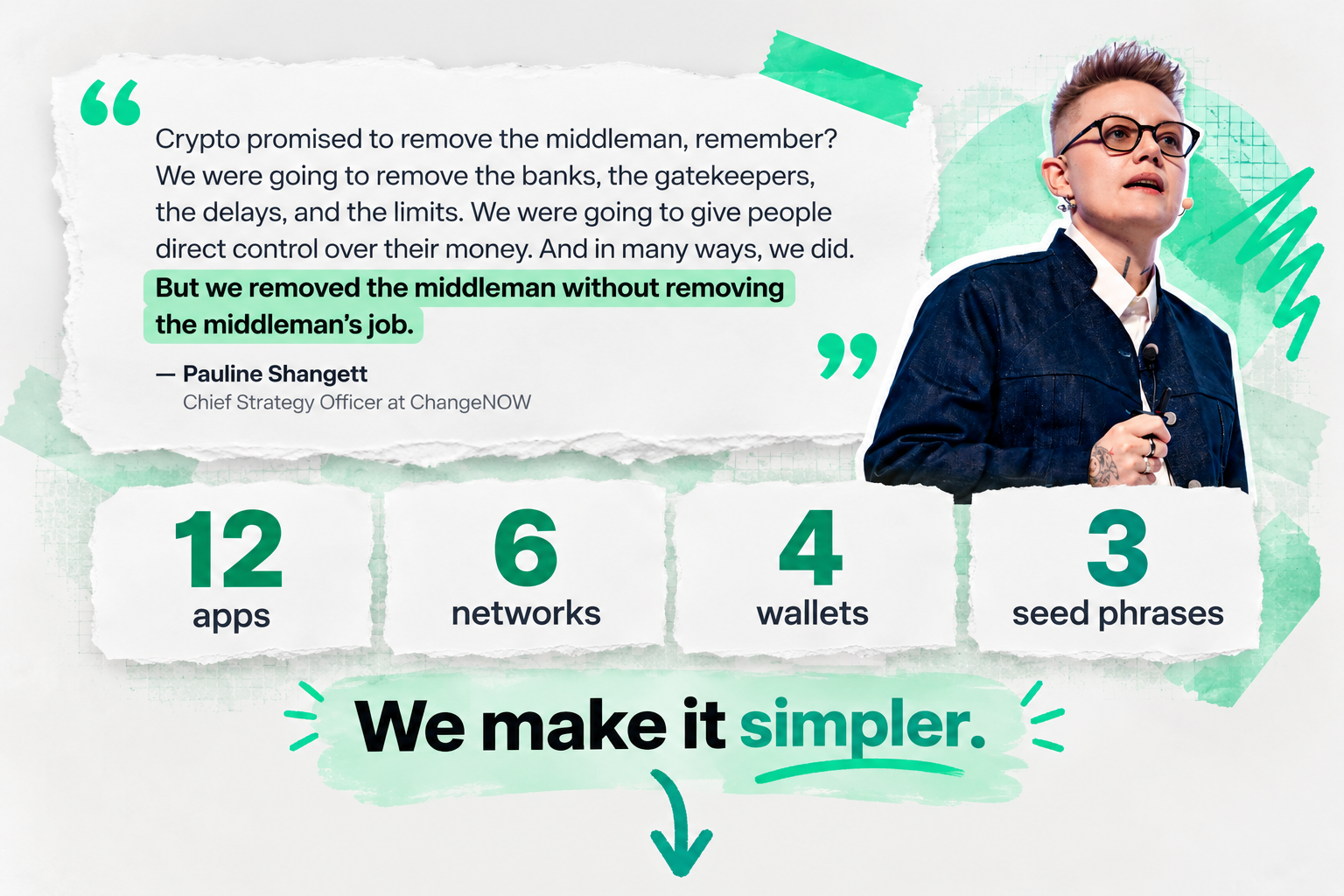
“A lot of the complexity is still pushed onto the user.”
For experienced users, reviewing transaction details may be routine. For newcomers, these decisions introduce unfamiliar technical risks into simple financial actions.
A better division might look like this:
Users need to understand
Products can increasingly handle
What asset is being moved
Network routing
Where funds are going
Gas management or sponsorship
What the transaction costs
Multiple underlying transactions
Whether an action is irreversible
Infrastructure terminology
What permissions they are granting
Sensible default settings
What happened if something fails
Technical transaction states
Krishna Kumar, Growth Lead at RocketX, made a similar argument at TOKEN2049:
“They don't have to think about which chain they are sending and receiving.”
RocketX addresses this challenge by aggregating liquidity sources into a unified interface and API, reducing the need for users to navigate individual providers and cross-chain routes themselves.
Sean Monahan, COO at Banxa, approached the problem from the infrastructure side:
“It's too difficult for one to do everything. Everyone needs to have their niche and work together and power it together.”
Different providers can handle specialized functions behind the scenes while the user interacts with a single, connected experience.
How Account Abstraction Can Improve Web3 UX
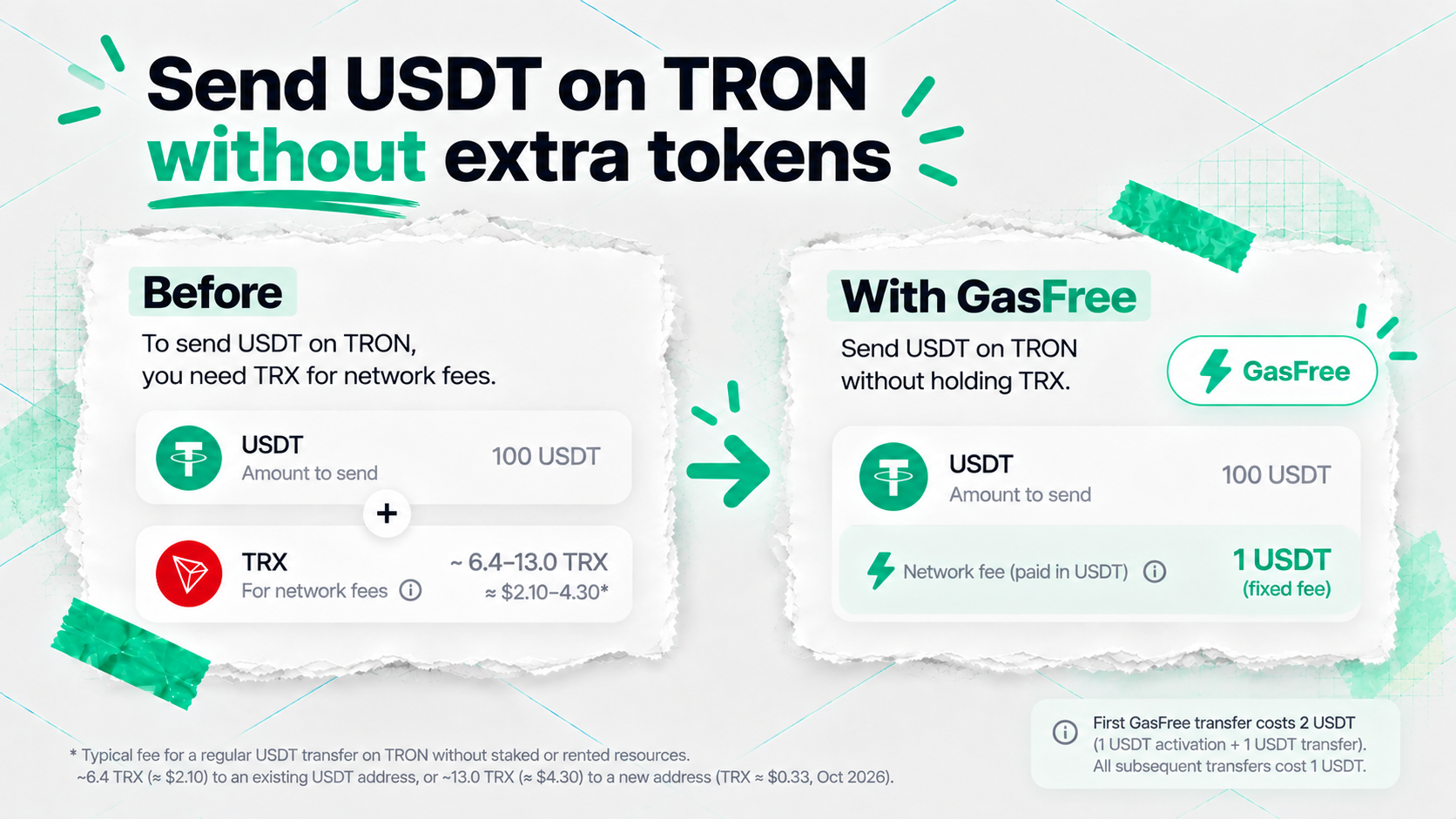
Account abstraction can simplify Web3 UX through features like gas sponsorship and fewer manual steps. More broadly, crypto products are finding ways to remove unnecessary technical requirements.
Better crypto wallet UX design is more than simply removing buttons.
Hide too little and the interface looks like it was built for blockchain engineers. Hide too much and users may no longer understand what is happening to their assets.
Tim does not think the answer is one simplified interface for everyone.
“You can't design for everyone by providing the same interface to everyone.”
Instead, products can work in layers.
“We try to think in layers. The fundamental experience should be clear even if you have no idea what a blockchain, gas cost, or network confirmation are. More seasoned users should also have access to the relevant data and controls.”
A first-time user may primarily need to know the amount, destination, fee, expected result, and whether the product has detected an obvious problem.
An experienced user may want network information, routing details, transaction data, or more granular controls.
The goal is to stop demanding technical knowledge before that knowledge becomes useful.
Self-Custody Without the UX Punishment
There is no way around the fundamental trade-off.
“Self-custody gives users control over their assets, but it also makes them responsible for protecting that access.”
But crypto has sometimes stretched that principle remarkably far.
Keep these words safe forever.
Make sure you have another asset available for gas.
Check the network yourself.
Verify the address.
Understand what this signature allows.
Understand when a transaction becomes irreversible.
Make one mistake and you may discover that the explanation comes after the loss.
That is a demanding secure onboarding process for first-time crypto users.
Tim argues that the expectation placed on users has gone too far:
“The industry needs to stop assuming that users should become security experts before they are allowed to participate in Web3. The technology underneath can remain complex. The user doesn't need to feel that complexity every time they open the app.”
Good Crypto UX Matters Most When Something Goes Wrong
Tim asks a useful question:
“Everything works, and every platform looks good, but what happens during a malfunction?”
A transaction remains pending.
Funds do not appear.
The user selected the wrong network.
They do not understand what they signed.
An irreversible transaction has already been confirmed.
At that point, a clean interface is not enough.
Can the product tell the user what happened?
Can it distinguish between “wait” and “action required”?
Can it explain what can still be done?
Does support understand the underlying transaction well enough to provide a useful answer?
For Tim, this is closely tied to trust.
“Trust isn't built by promising that nothing will ever go wrong, but rather by demonstrating consistent reliability and integrity.”
That concern extends to the availability of support. During the TOKEN2049 discussion, WalletConnect's Diana Alexandrova put the user's perspective into words:
“I would be very scared if there was no one to talk to, if my money got lost or I got robbed.”
Even when a transaction cannot be reversed, users still need somewhere to turn for an explanation and guidance on what to do next.
Crypto Onboarding and Compliance Can Work Together
Compliance creates an uncomfortable product problem because some friction cannot simply be removed. Users want fast transactions, but platforms may have obligations related to sanctions, fraud prevention, AML requirements, and other risks.
A review that appears without explanation, gives no indication of what information is required, and leaves the user uncertain about what happens next creates a very different experience from a transparent process with clear steps.
“The mistake lies in treating compliance and user experience as completely opposing things. In reality, effective systems can implement necessary controls in a less disruptive way.”
Risk-based systems are one way to reduce unnecessary disruption. Additional scrutiny can be concentrated where risk actually requires it instead of forcing every user through identical checks.
Privacy creates another layer of tension.
Users can have legitimate reasons to limit how much financial information they expose. Platforms still have responsibilities around fraud, sanctions, and regulation.
Harry Bridge, Commercial Lead for Stablecoins at Aztec Labs, discussed one possible approach at TOKEN2049: using zero-knowledge proofs to verify certain user attributes without disclosing the underlying personal information.
For example, he described how users could prove they meet age or sanctions-related requirements without handing over their complete passport data.
Such technologies cannot replace every compliance requirement, but they demonstrate how privacy-preserving verification could reduce unnecessary data exposure during onboarding.
Tim does not see those goals as automatically incompatible.
“I don't think privacy and compliance should be considered opposites by default. The challenge lies in creating systems that address these requirements in a responsible manner, without making every user interaction a compliance exercise.”
The objective of good onboarding is to remove friction that serves no useful purpose and explain the friction that does.
What Better Crypto UX Actually Looks Like
For years, crypto could reasonably expect many of its users to learn how the machinery worked. Early adopters were often willing to do that because understanding the technology was part of the appeal.
Mass-market users are a different audience.
Telling them to “do more research” every time the interface exposes another infrastructure problem is convenient for the product. It does not fix the product.
A better direction is practical:
automate infrastructure decisions when there is a safe default;
warn about mistakes before a transaction rather than explaining them afterward;
make transaction signing understandable;
reduce dependence on seed phrases where secure alternatives are available;
connect actions users already see as part of one financial journey;
explain compliance checks and transaction problems in plain language;
keep advanced controls available for users who actually want them.
This is also why adding more features is not enough.
Tim puts the standard differently:
“Ultimately, I don't think the winning crypto products will be the ones with the longest feature list. They'll be the ones that make a complicated financial system feel simple without taking away the user's control.”
Crypto does not have to make blockchains simple. It has to stop making every user understand why they are complicated.
Watch the full TOKEN2049 panel discussion to hear the industry experts share their perspectives on crypto adoption, user experience, and the future of digital finance:
FAQ
Crypto UX is the experience users have when interacting with wallets, exchanges, payments, transactions, and other blockchain-based products. Good crypto UX reduces unnecessary technical work while keeping costs, risks, permissions, and financial actions understandable.
Crypto onboarding can expose unfamiliar concepts such as seed phrases, wallet addresses, networks, gas fees, signatures, and transaction confirmations. Products can reduce this friction through clearer interfaces, safer defaults, smarter wallets, and better explanations.
Account abstraction allows wallets to support features such as gas sponsorship, transaction batching, flexible authentication, and alternative recovery mechanisms. These capabilities can reduce the number of technical steps users have to manage themselves.
Yes. Simpler onboarding can preserve self-custody while improving authentication, recovery, transaction warnings, and infrastructure handling. Users still control their assets, but the product does more to prevent avoidable mistakes.