


Paying one person in crypto is easy. Paying 5,000 people is an infrastructure problem, especially when some of them do not even have crypto wallets.


Paying one person in crypto is easy. Paying 5,000 people is an infrastructure problem, especially when some of them do not even have crypto wallets.
Crypto mass payouts automate this process through CSV uploads or APIs. And with NOWPayments and ChangeNOW Pro, businesses can go a step further: send payouts by email, without collecting a wallet address from every recipient.
This makes mass payouts scalable not only for crypto-native users, but for anyone a business needs to pay.
Crypto mass payouts, sometimes called bulk or batch payouts, allow a business to send cryptocurrency to many recipients through one coordinated process.
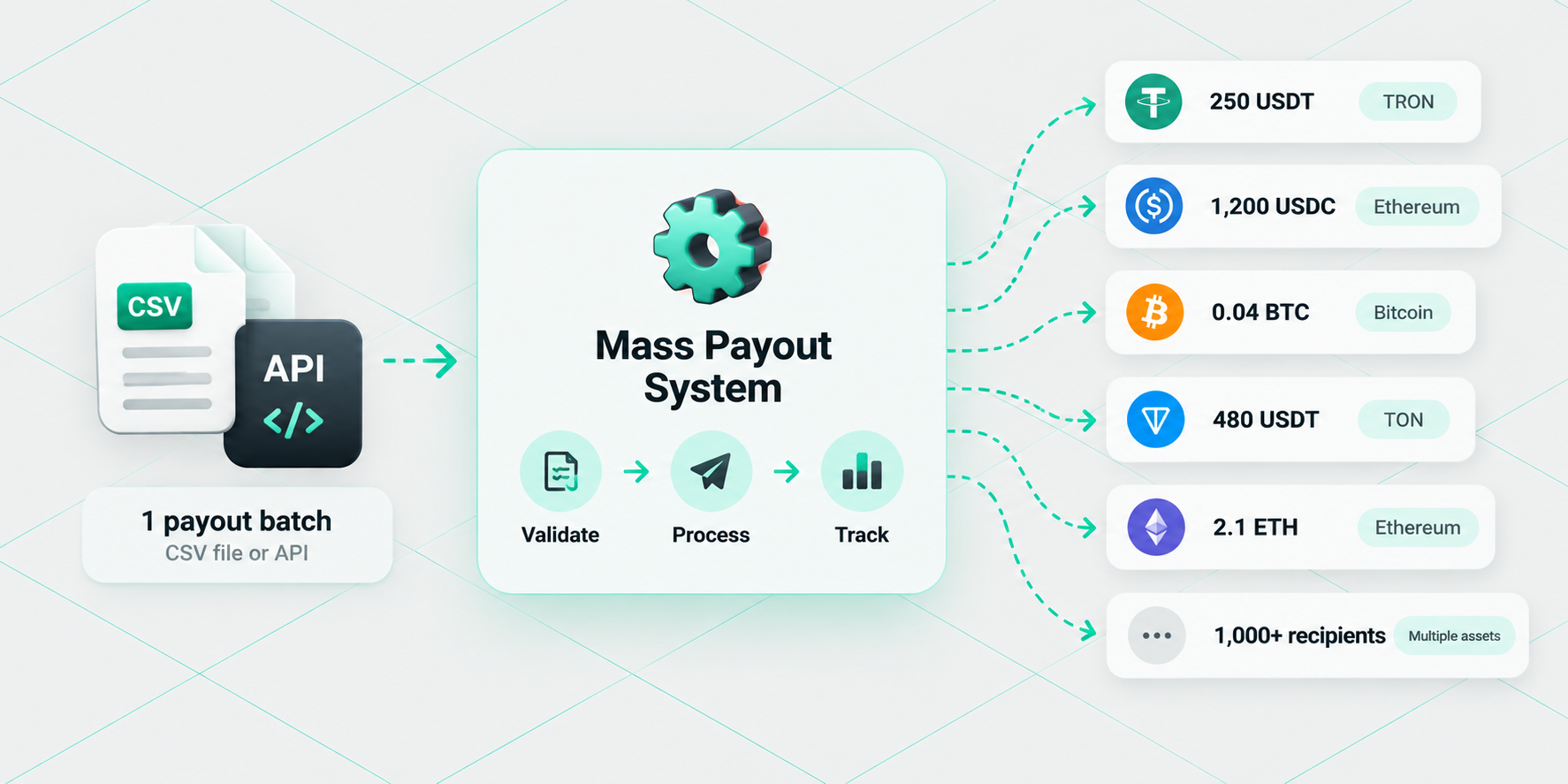
Traditionally, crypto mass payouts are wallet-based: the sender collects a blockchain address and, where necessary, network information for every recipient.
A typical wallet-based payout list may contain hundreds or thousands of entries, each specifying information such as:
The business submits the list through a dashboard, CSV file, or API instead of initiating every transfer individually.
The recipients still receive separate payouts, but the workflow changes. Hundreds of payment instructions can be prepared, validated, executed, and tracked as one payout operation.
Account-based payouts change one important part of this model. Instead of requiring an external wallet address from every recipient, they can use an account identifier such as an email address.
The first problem is data accuracy. Businesses have to make sure that every address matches the intended recipient and, where relevant, the correct blockchain network.
Then there is network management. USDT alone exists across multiple networks. An address, asset, and network have to form a valid combination before a payout can safely be sent.
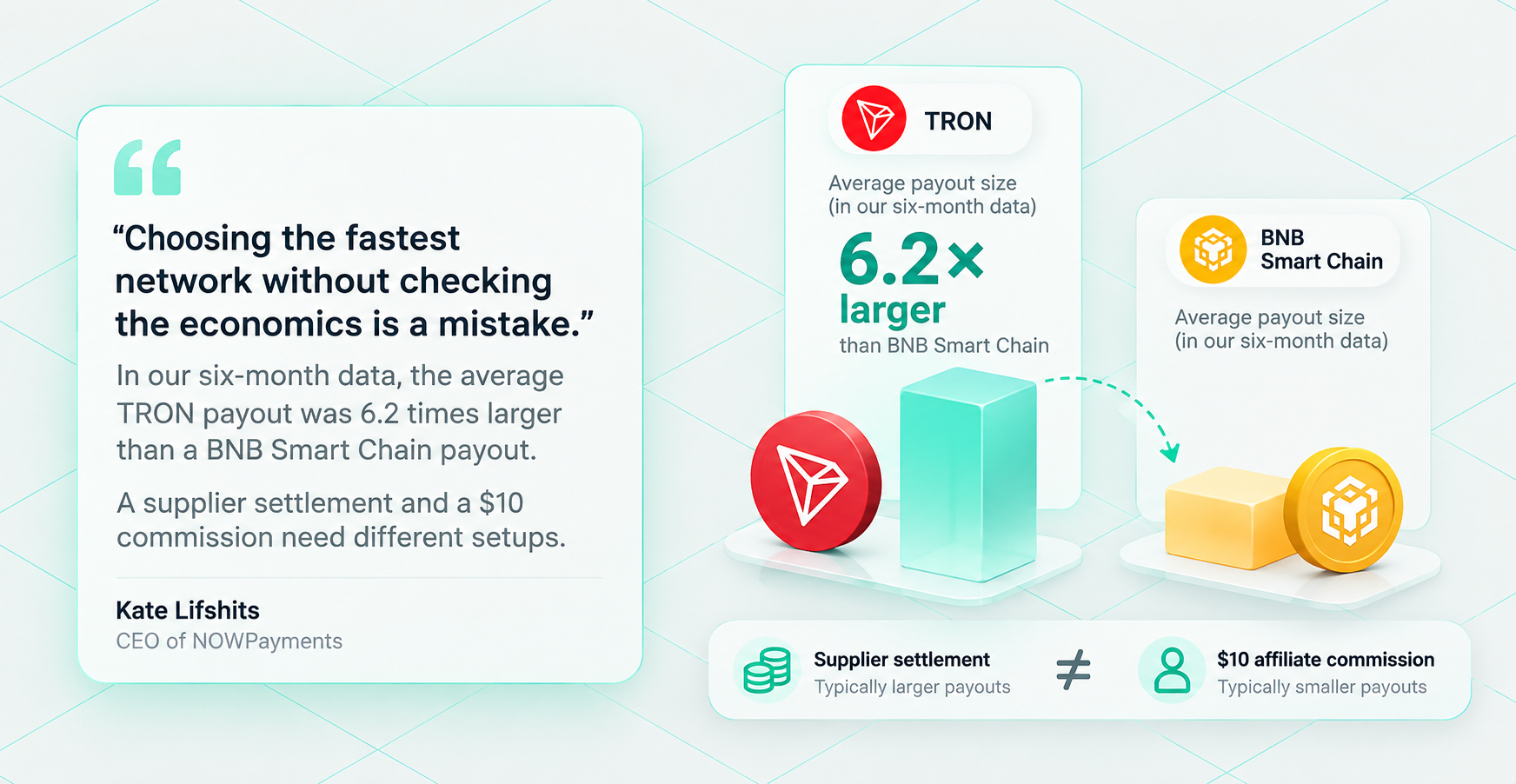
But technical compatibility is only part of the decision. The economics also need to match the payout pattern. In NOWPayments’ six-month data, the average TRON payout was 6.2 times larger than the average BNB Smart Chain payout, illustrating why a supplier settlement and a $10 affiliate commission may call for different setups.
Businesses additionally need to deal with:
As Kate Lifshits, CEO of NOWPayments, puts it:
“If your payout volume grows tenfold and your finance team has to grow with it, you’ve scaled the workload. The business still needs a better process.”
Although implementations differ between providers, the basic process usually looks like this:
The business determines who needs to be paid, how much each recipient should receive, and in which asset.
For conventional wallet-based payouts, this means collecting the appropriate blockchain addresses and network information.
Account-based models can instead identify recipients through an account credential such as an email address. This removes the need to collect an external wallet address before initiating the payout.
Submit the batch. The payout data is uploaded as a CSV or sent through an API.
Validate the data. The system checks whether required fields are present and whether payout instructions meet its formatting and operational requirements.
Fund the Payouts. The business needs sufficient crypto to cover the distribution and, depending on the model, applicable service or blockchain network fees.
Execute the Transfers. The provider processes the individual payouts and sends the funds to their destinations.
Track the Results. Each payout receives a status so the business can identify successful, pending, or failed transfers and reconcile them with its own records.
NOWPayments handles the business side of mass payouts, supporting CSV uploads, API integrations, 350+ cryptocurrencies, and batches of 1,000+ payouts.
For recipients without crypto wallets, businesses can send payouts by email through ChangeNOW Pro. Funds move within the ecosystem, enabling near-instant settlement without a blockchain network fee for the internal transfer.
With NOWPayments and ChangeNOW, recipients can get paid in a familiar way.
As Lifshits says:
“Every extra step between ‘I earned it’ and ‘I received it’ can become a support ticket. Email payouts remove the wallet setup and address collection from that journey.”
This works through ChangeNOW Pro. An account is created for the recipient’s email, giving them access to a crypto super app where they can trade, swap, cash out to fiat, and do much more with their funds.
Wallet payouts make sense when recipients already use crypto and want funds delivered directly to their own addresses. Account-based payouts reduce onboarding friction when the recipient may not have a wallet ready at all.
One of the first practical decisions is how payout instructions reach the provider.
A crypto mass payouts CSV upload service works well when payouts happen in scheduled batches. Payroll is an obvious example: the finance team may already have a monthly spreadsheet containing employees, amounts, currencies, and wallet addresses.
Kate points to a simple practical threshold:
“If customers have to wait for someone to upload a spreadsheet, I’d look at API. One marketplace already uses our integration for both automated fulfillment and supplier payouts. Payouts shouldn’t need their own manual routine.”
The workflow can remain human-controlled: export the data, review it, upload it, approve the batch.
An API makes more sense when payouts are part of the product itself.
Imagine a marketplace where sellers request withdrawals every day. Exporting those requests into a spreadsheet and uploading them manually creates an unnecessary operational bottleneck. An API lets the marketplace generate payouts from its backend.
| CSV Upload | API | |
|---|---|---|
| Best for | Periodic payout runs | Continuous or high-frequency payouts |
| Setup | Minimal | Development required |
| Human involvement | Higher | Lower |
| Automation | Limited | High |
| Typical use | Payroll, monthly affiliates | Marketplaces, gaming, platforms |
| Scaling | Good for batch operations | Better for embedded payout flows |
The underlying problem appears anywhere one sender repeatedly owes money to many recipients.
Distributed teams can include employees and contractors across multiple countries. Instead of arranging separate international transfers, payroll platforms can enable crypto payouts and distribute assets such as stablecoins directly to recipient wallets.
Stablecoins are particularly useful here because payroll amounts can be denominated in a relatively stable unit rather than a volatile asset.
A freelance platform may need to settle hundreds or thousands of completed jobs.
Mass crypto payouts let the platform convert an internal ledger of freelancer balances into an executable payout run rather than manually processing each withdrawal.
Affiliate programs are almost built for mass payouts: many recipients, recurring commissions, and widely varying payout sizes.
Once commissions have been calculated, a payout system can turn the resulting recipient list into a single distribution workflow.
Marketplaces collect money from buyers but ultimately need to settle with sellers.
For global platforms, crypto can provide another settlement rail alongside traditional banking, while mass payout automation handles the one-to-many distribution.
Gaming platforms, competitions, loyalty programs, creator products, and reward systems can generate huge numbers of relatively small payouts.
In these cases, manual processing becomes economically absurd long before it becomes technically impossible. Automation allows payouts to become part of the product rather than a back-office chore.
According to Lifshits, the strongest demand is coming from businesses where payouts are frequent and directly affect the user experience:
“I’d highlight payroll, affiliates, gaming, and marketplaces. Frequent payouts make every fee count. One marketplace partner pays suppliers in the same USDT it receives from customers, on the same network. That removes the FX spread and keeps more margin in the business.”
Crypto makes cross-border payouts easier, but businesses still need to choose the right assets, networks, and payout method.
For wallet-based payouts, this means collecting the correct address and network from every recipient. Account-based payouts can simplify the process by using an email instead. CSV works well for occasional batches, while an API makes more sense for continuous payouts.
Businesses also need to account for local compliance requirements. Crypto can move globally, but the companies using it still operate under real-world rules.
A useful mass crypto payouts solution should solve more than the final act of broadcasting transactions.
At minimum, businesses should look at:
Blockchains already know how to transfer value. The challenge is making thousands of payouts accurate, secure, trackable, and easy for recipients to receive.
At ten payouts, those differences may barely matter. At ten thousand, they become the product.

ChangeNOW at TOKEN2049 Singapore: Where to Find us During This Week
ChangeNOW's guide to its TOKEN2049 Week in Singapore: where to find the booth, when its team speaks, and how to get into its own and partner side events.

What Is a Crypto Super App? Why the Next Billion Users Should Never Touch a Blockchain
Discover how to cut a crypto payment from eight steps to one. ChangeNOW's Pauline Shangett on the iced latte problem and why crypto needs super apps.

NOW Token Burns: How ChangeNOW Manages $NOW Supply
See the full burn history and how $NOW is used across the ChangeNOW ecosystem.