Welcome to the ChangeNOW Blog. Here we focus on research, real use cases, and practical insights — not hype. While we double-check our facts, nothing here should be taken as financial advice; crypto is a high-risk space, and your own research always matters.
Between mid-2021 and the end of 2025, over 20 million tokens launched, but CoinGecko reports that more than half are now dead. In 2025 alone, about 11.6 million failed. Most didn't collapse because of technical issues or lost liquidity. Instead, they faded away because no one stayed interested. Even if the token still traded and the Discord was online, the community had already moved on.
That's the blind spot in community building in crypto. A clean technical launch doesn't buy lasting success, and community tends to get treated as a task to slot in between the audit and the token launch rather than the thing that keeps a project running once the early excitement fades. A busy chat room gets mistaken for a community, but the two aren't the same.
A real Web3 community is a group of people invested in the project who feel a sense of ownership and want to move it forward; members often hold part of the protocol, so they can act together in ways a Web2 audience never could. Ownership is what turns a member into an advocate. They follow the news because part of the outcome is theirs, and they bring in the next wave of users at a cost no ad budget can match. Retention and token adoption both depend on that loop staying alive.
Key Takeaways
A community is a product with its own onboarding and retention, not a channel for announcements.
Work out why the project needs a community and what type it is before choosing channels, hires, and metrics.
People who join only for the token leave the moment the price drops. A community that holds through a bear market offers value beyond the chart: belonging, status, a product members actually use.
A community is driven by an architect, not a moderator. Moderation keeps the channel from rotting but moves no one through it.
Retention is engineered on purpose, and the thing you reward is behavior worth having.
Member count flatters you the most and teaches you the least. A 50,000-member group can be dead; what tells you it's alive is behavior — daily active participants.
Determine your community strategy
Picture a Discord with 50,000 members where the only accounts still posting are bots. That is the predictable endpoint of the way most communities get started: off a checklist, because every other project has one, with no KPI attached and no plan for either growth or retention.
A strong community does not begin with a platform choice. Crypto community building begins with a plausible answer to one question: why does this project need a community at all? The answer dictates the rest — the channels you open, the people you hire to run them, and the numbers you watch. Skip it, and you inherit the ghost server.
Not every project needs one, and it is worth pressure-testing before you commit:
Before you build, ask honestly:
— Does the positioning actually call for a community, or would it just be decoration?
— Do the people you want expect to interact with the product through a group, or would they rather be left alone?
— Can the value proposition even travel through social media in the first place?
— And if it can, is there anyone on the team who can carry it there consistently?
If the honest answers point away from a community, the discipline is not to build one.
Once you decide to build, the type you are building sets everything downstream — how you staff it, how you structure it, and what counts as success. Crypto community building strategies split into five different products here, each with its own operating model:
Community type
Primary business goal
Success looks like
Support channel
Cut support load, hold users
Faster resolution, fewer repeat tickets
Governance hub
Real decision-making
Members actually voting on outcomes
Loyalty club
Retention and lifetime value
Repeat activity over months
Acquisition funnel
Lead generation
Qualified referrals coming in
Education platform
Onboarding and adoption
Newcomers reaching first real use
Trying to be all types at once doesn't work. If you ask a group to be both a support desk and an acquisition funnel, it ends up serving neither. More importantly, people shouldn't join just for the token. If everyone is only waiting for a price jump, they'll leave as soon as the price drops. Your community needs to offer value that lasts through tough times.
Case: Pudgy Penguins is the cleanest proof of that. It started as an NFT collection and became a brand: by the project's own recap, more than a billion GIF views and 100,000 Instagram followers inside six months, later plush toys on Walmart shelves and a licensing model built on the IP. When the crypto winter came, the community held, because belonging to the brand was the value and the chart was incidental to it. The $PENGU token arrived later, as an extension of momentum that already existed rather than the reason anyone was there.*
That reframing is worth stating plainly, because it changes how you run the thing. A community is a product. It has its own onboarding and its own retention loops, and it earns attention the way any product does. It is not a distribution channel for announcements, and teams that treat it as one — a place to broadcast into — get the engagement that broadcasting earns.
On the practical side, the platform should follow the product. Rather than running everything everywhere, match the venue to what you are:
Platform
Strongest for
Why
Discord
GameFi, projects with many moving parts
Roles, topic channels, live coordination
Twitter
NFT and brand-led plays
Visual reach and virality
Telegram
Fast announcements, high-tempo chat
Speed and low friction
The mistake is running all three at full effort from day one. Split the traffic by where the volume actually is, and put real work into navigation and pinned links, so the resources people come looking for are one click away.
Structure follows from there:
What a working structure actually has:
— Channels organized by interest, not by org chart
— Roles with a visible path to progress through them
— Programming on a schedule people can count on
— AMAs that are an actual conversation, not the team talking at a wall
— Governance where votes genuinely change outcomes
If votes don't lead to real changes, members quickly learn their input doesn't matter. This is the quickest way to empty out your community.
Hire strong community managers
Moderator vs. architect
Most projects hire someone to "manage" the community and end up with someone who moderates a chat. The distinction matters more than it sounds. Moderation is real work: clearing spam, muting scam links, keeping a human online across time zones so the channel doesn't rot into a wasteland of phishing inside 48 hours. Skip it, and everything falls apart. But do it well, and nothing gets built either, because moderation only keeps the space from degrading. It doesn't move anyone through it.
What the role actually needs is someone who designs the path a member travels. That means an onboarding route that turns a confused newcomer into a power user and eventually into someone who advocates for the project without being asked. It means spotting the community's organic leaders and giving them room to grow. It means running actual programming, and caring more about whether someone is still around on day 30 than about how many people wandered in on day 1. The daily texture of the job is the floor, not the job: welcome messages, a response expectation under ten minutes, weekly news reposts, and reporting back on what's working. A founder who reads that routine as the whole role is exactly how a moderator gets mistaken for a strategist.
Moderator
Community architect
Clears spam, mutes scam links
Designs the newcomer → power user → advocate path
Keeps the chat from rotting
Builds something worth staying for
Reacts to what's happening now
Owns what keeps someone around on day 30
Measured by uptime and response speed
Measured by retention and organic leaders raised
Hire from inside the community
The best hire usually already belongs to the community. Active members know the project and the people in it; they carry hard-won reads on what drives engagement, and they can cool down a conflict because they built the relationships that let them. Watch who answers other users' questions unprompted, or who revives a dead thread with a well-timed meme, then reach out privately to find out whether they're interested and how many hours they can give. It outperforms a freelancer marketplace, where you get someone who has to learn your world from scratch.
Set the manager up before launch
None of it runs on instinct alone. Hand the manager written guidelines before launch, especially when the person you brought on has only ever moderated and still has to learn the rest of the job. Protect their time and everyone else's: don't let engineers burn their day answering the same technical question in the channel when they should be shipping, which is exactly the problem a public FAQ or an internal reference bank solves, letting support scale without pulling builders off the product. And keep in mind that these communities never sleep. They're live 24/7, 365 days a year, so a team clustered in one time zone, or one that logs off together for a national holiday, leaves the room unattended while it's still full. Scaling past that point doesn't come from hiring more moderators. It comes from turning members into leaders, the part of Crypto community building that separates a channel that survives from one that grows, and it's what the next section builds toward.
Implement retention mechanisms
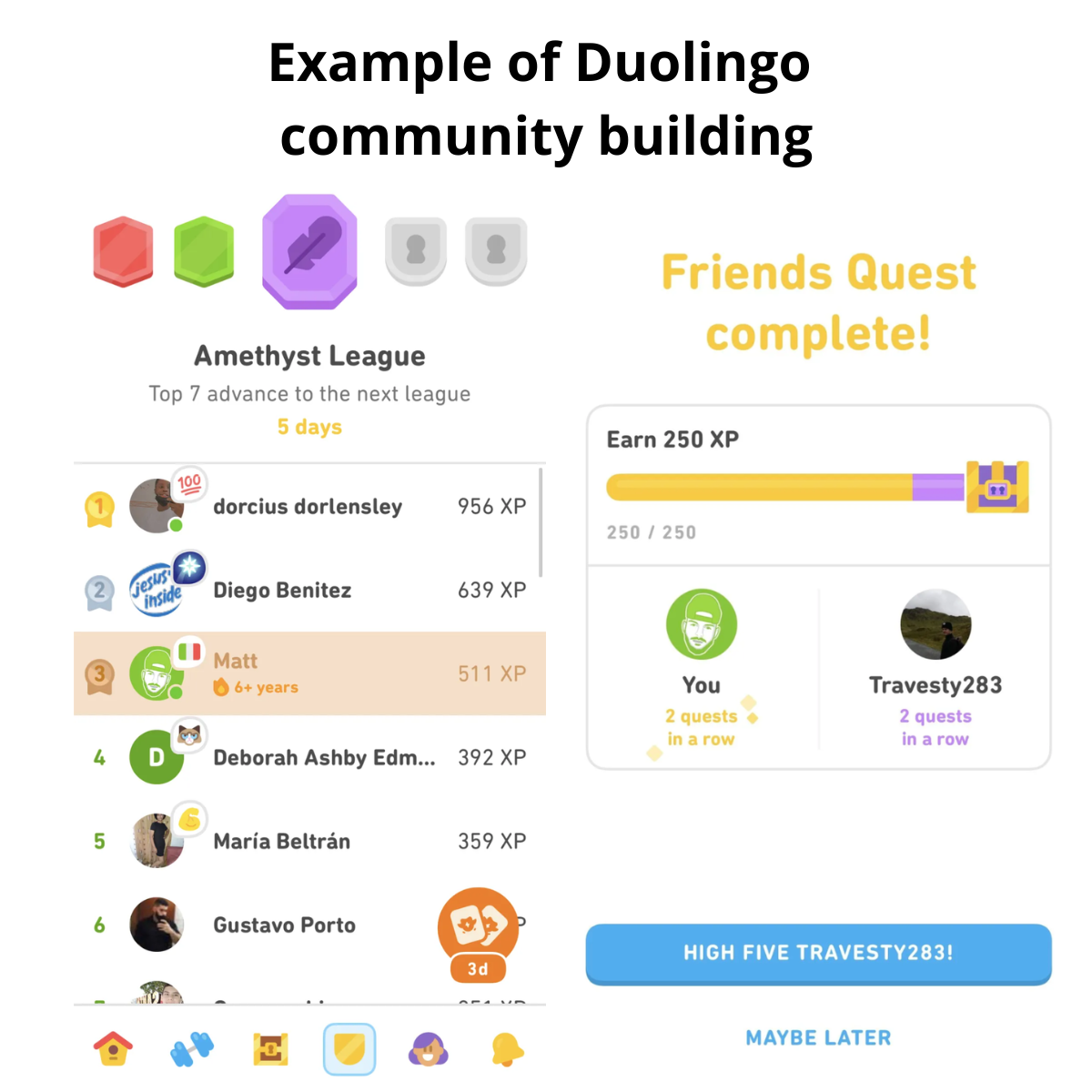
Retention doesn't happen by accident. Most Web3 communities don't offer progression, meaningful rewards, or any difference between new and long-time members, so people end up just lurking. Consumer brands like Nike Run Club, Starbucks, Duolingo, and Peloton engineer the opposite: their community building best practices map onto retention systems most projects never bother to copy.
Gamify the behavior, not the noise
Gamification is where most projects go wrong, because they treat it as a launch stunt instead of a system. Points for the sake of points are worthless; points tied to a behavior worth having are a growth engine, and the difference is entirely in what you choose to reward. The crypto community building tools already exist for all of this: platforms like Galxe handle quests, credential-based rewards, and on-chain verification of who actually did what. Yet the common pattern is one campaign at launch, then abandonment, the way last cycle's NFT collections were left to go quiet.
Reward this
Not this
XP for governance participation
XP for posting "gm"
Leaderboards ranked by contribution
Leaderboards ranked by who's loudest
Standing for a six-month contributor
Same status for an airdrop-day arrival
Quests that teach the protocol
One launch campaign, then silence
Recognition, status, and gating
Recognition is a powerful tool. Highlight your most active contributors and make sure long-term members have a different status than those who just showed up for an airdrop. Credential systems can track participation automatically. Token-gating also helps by focusing the group on people who truly care. For example, Lobster DAO has both an NFT-gated chat and an open one, and both stay active because members share a real interest. The best way to scale recognition is to promote top members—give them roles, governance power, early access, and direct contact with the team, then let them lead their own groups and events.
Token incentives, handled carefully
Token incentives can anchor loyalty early, rewarding people for using the product before it's fully built and giving everyone skin in the same game. But that only holds when they're structured with care, because a poorly designed reward does real damage. It pulls in grifters and quick-buck tourists instead of users, and paying for what committed members would have done for free drains the budget while poisoning the culture before it sets. That's the reason to design distribution with someone who knows tokenomics: reward the committed, keep it fair, use locking and vesting to price out spammers, and reserve supply for the users who show up two, five, and ten years from now. All of which raises a question the rewards themselves can't answer: where that token actually lives, trades, and gets its price.
Provide additional value for your users
Utility they can act on
Rewards and status attract people, but they don't keep them once the excitement wears off. Real utility is the part of Crypto community building most projects skip: members need to be able to do meaningful things, not just wait for updates.
If your product has its own interface or wallet, the most direct move is to let people swap without leaving. Send a member off to a third-party exchange mid-session, and you often lose the session; embed it instead and swapping happens in place, non-custodially, with members keeping control of their funds. That opens more than 1,500 coins across 110+ networks, with liquidity from both centralized and decentralized venues, so members reach cross-chain routes and thin pairs a single exchange won't have. A fiat on- and off-ramp, available on request, lets the newcomers you're trying to retain move from cash into crypto without going elsewhere.
Working with ChangeNOW
For swaps, ChangeNOW manages the integration. They provide an exchange module, a top-up module for deposits in any supported asset, a WordPress plugin, and a Telegram bot, all working across web and mobile. They also handle nodes, maintenance, and updates. Their reliability—99.99% uptime and a 350 ms response time—means you won't have to worry about issues in front of your members.
List your token. Listing on ChangeNOW lets you spin up a custom liquidity pool paired with any supported asset: set a starting price, provide liquidity, and let price discovery run off real demand, with the mechanics handled for you. A six-month listing extends for free once monthly swap volume clears $100,000, so an active community directly earns better listing economics.
Where you enter depends on where the token already is. An asset that trades on a CEX or DEX, is tracked on CoinMarketCap, and has a real liquidity pool takes a standard listing. One not yet supported for exchange, or needing to connect across networks for a migration or mainnet bridge, goes through a multichain bridge with no service fees.
A reason to check in
Price alerts and market updates give members a reason to open the community on an ordinary day, not only when the chart moves. That's informational value the community produces on its own, no product attached.
Onboarding that scales
Tutorials, product walkthroughs, and beginner support move a confused newcomer to a confident user, and confident users are where advocates come from. It's the onboarding logic your community manager already owns, delivered as content.
Choose metrics to track
A 50,000-member group can be dead. If the only people posting are bots and the one guy asking "wen token," the header number tells you nothing about whether anything is alive underneath it. Member count is the metric that flatters you the most and teaches you the least, which is exactly why so many projects lead with it.
Behavior is the thing to watch:
Daily active participants tell you how many people actually show up, and the ratio of lurkers to contributors tells you whether the room has a pulse or just an audience.
Quest completion and governance participation show whether the mechanics you designed earlier are pulling anyone in.
Retention at 7, 30, and 90 days shows the shape of real health. A community that keeps people past the first week but loses them by the second month has a different problem than one that never hooks them at all.
Conversion is the metric tied to why the community exists in the first place: how many members become people who actually use the product. An active community that swaps generates volume, and that volume is what earns better listing terms downstream.
Qualitative feedback comes before any of that. Each month, pull what members actually experience with the product, what they want built next, where the friction is, and which content they respond to, then feed that into the following period's plan. The quantitative side tells you something moved; the qualitative side tells you why, and only one of those is actionable.
Set your benchmarks from outside before you judge yourself against them. Watching how comparable Web3 communities in your market perform gives you a rough early-stage reference for where an active project tends to land on each platform. Treat those figures as context, not a scoreboard. The moment a size figure becomes the target, you're back to optimizing the vanity number this whole section exists to talk you out of.
Checklist for crypto community building
Every step here is easy on its own. Skip one, and you're back to a community that's nothing more than a number, which is how roughly 11.6 million tokens ended up dead in 2025.
Decide why the community exists, and what kind it is. The business goal and the community type set everything downstream, from which channels you open to how the room is structured.
Hire a community architect, not just someone to clean up. The community manager should set the culture, design systems, and understand the group. If they only delete spam, you're just maintaining an empty space.
Engineer retention on purpose. Loyalty rewards, status and recognition, token-gated access, and a real sense of belonging are the crypto community building tactics that keep people past the first week.
Give members utility they'd miss if it vanished. Instant swaps, price alerts, tutorials, and beginner support turn a chat into something people open on their own.
Measure behavior, not headcount. Daily active participants, retention curves, and conversion into product users tell you what the member count never will.
List the token when the demand is real. Once the community generates genuine token demand, listing it is what turns that demand into adoption.
Listing on ChangeNOW won't fix a community that was never built. Swap volume and liquidity don't substitute for the work in the sections above: the reason to exist, the architect who runs the room, the retention loops that hold people past week one. A listing meets a community once it's real. When the demand is there, the token reaches an audience through ChangeNOW's own traffic, and the liquidity runs deep enough that your members' swaps clear against real order flow. That reach and that depth are slower to build alone than with a partner who already carries the volume.