Welcome to the ChangeNOW Blog. Here we focus on research, real use cases, and practical insights — not hype. While we double-check our facts, nothing here should be taken as financial advice; crypto is a high-risk space, and your own research always matters.
Unifying Liquidity: Bridging the Gap
The move to multichain boosted scalability but fractured capital efficiency: instead of progress, we’re left with isolated networks and trapped assets. Cross-chain bridges are now essential, acting as the critical link that unifies these fragments into a single economy, as explained in this overview of multichain bridges.
Retail users need it to chase yield across L2s without being eaten alive by gas, while B2B operations use it for cross-chain settlements and treasury management. In 2026, if a project is locked to a single network, it’s effectively cut off from the rest of the industry’s liquidity. That’s why we have analyzed the top crypto bridges.
In our analysis, we found that when you are looking for actual performance and security, ChangeNOW is the best crypto bridge for high-velocity moves. It avoids the typical "speed vs. safety" trade-off by remaining strictly non-custodial—you move assets across chains without ever losing control of your keys. For developers, it’s a high-leverage tool; the API and widgets allow for rapid integration, letting dApps go multichain in days rather than months.
By 2026, the specific chain matters less than the friction of moving between them. We’ve stopped asking which blockchain will "win"—the focus has shifted entirely to who provides the fastest, safest route to get where the capital is.
The List of Best Crypto Bridges
Below is a breakdown of the top crypto bridges in 2026 based on real execution conditions.
ChangeNOW
Stargate Finance
Synapse Protocol
Across Protocol
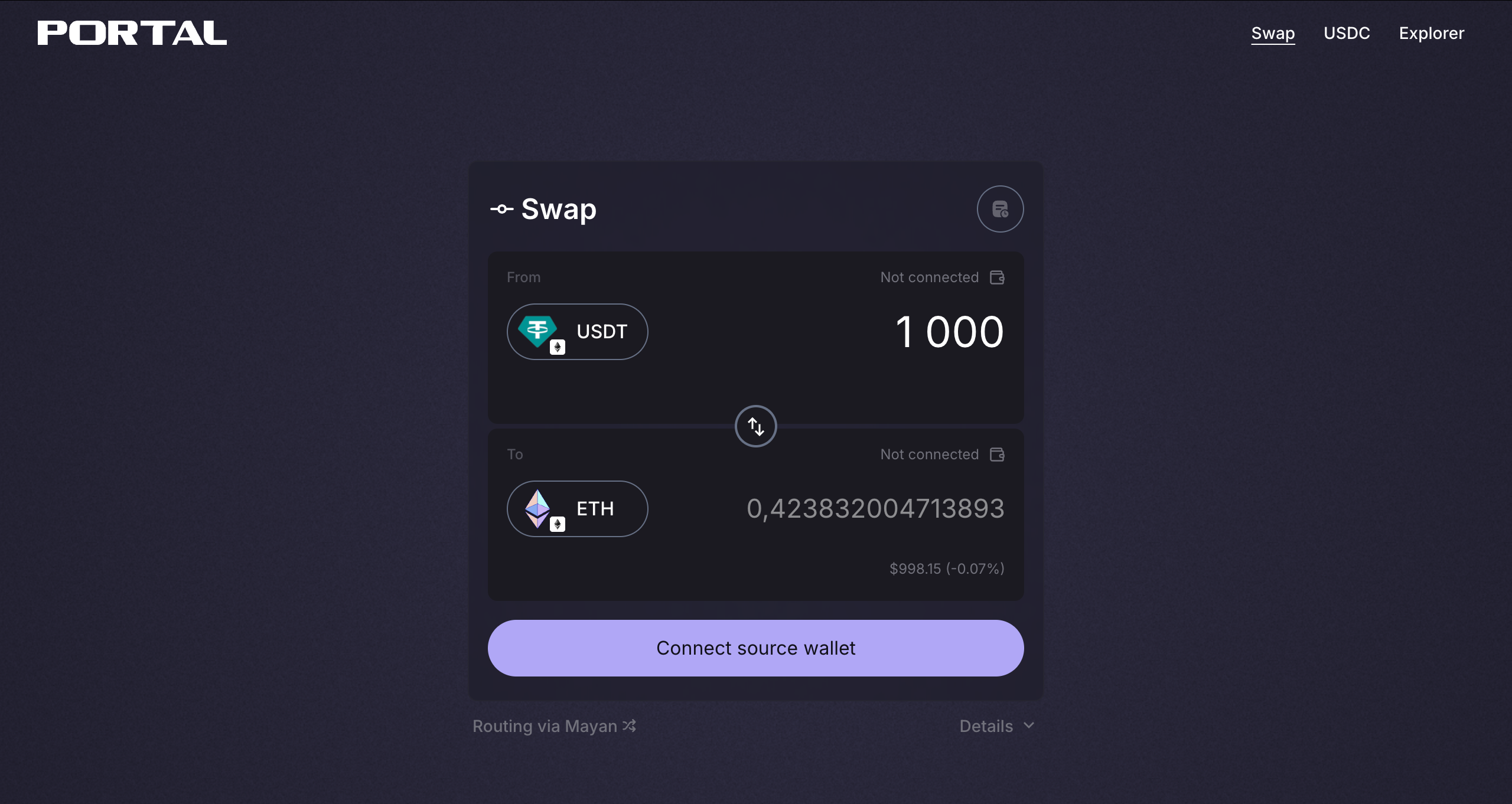
Portal
How We Analyzed: Evaluation Criteria
When selecting crypto bridges, the focus is on three variables: efficiency, reach, and security. This is the checklist used to evaluate whether a solution can operate at scale. The best cross chain bridge is defined by how it performs across all three.
Connectivity and Liquidity Depth: A cross-chain bridge must support a wide range of networks, including L2s and newer rollup architectures. Limited coverage restricts how assets can move. At the same time, connectivity without liquidity has little value. Shallow pools increase slippage, especially on larger transactions. Priority goes to protocols that can process high-volume swaps without significant price impact, particularly in cross-chain DeFi where capital is constantly in motion. A DeFi bridge with insufficient liquidity quickly becomes a bottleneck.
Fee Efficiency: Costs determine whether cross-chain movement makes sense. For users, high fees remove the advantage of switching to a cheaper network. For businesses, small inefficiencies accumulate across volume and affect treasury performance. The focus is on clear fee structures with minimal overhead and no hidden costs.
Integration and UX: Basic token transfers are not enough. The benchmark is direct swaps into native assets and a clear, predictable interface. For product teams, integration speed is critical. API and widget quality define how quickly a bridge can be deployed. If integration requires extended development time, it introduces operational delays instead of solving them.
Each bridge platform differs in its execution model, liquidity design, and cost structure:
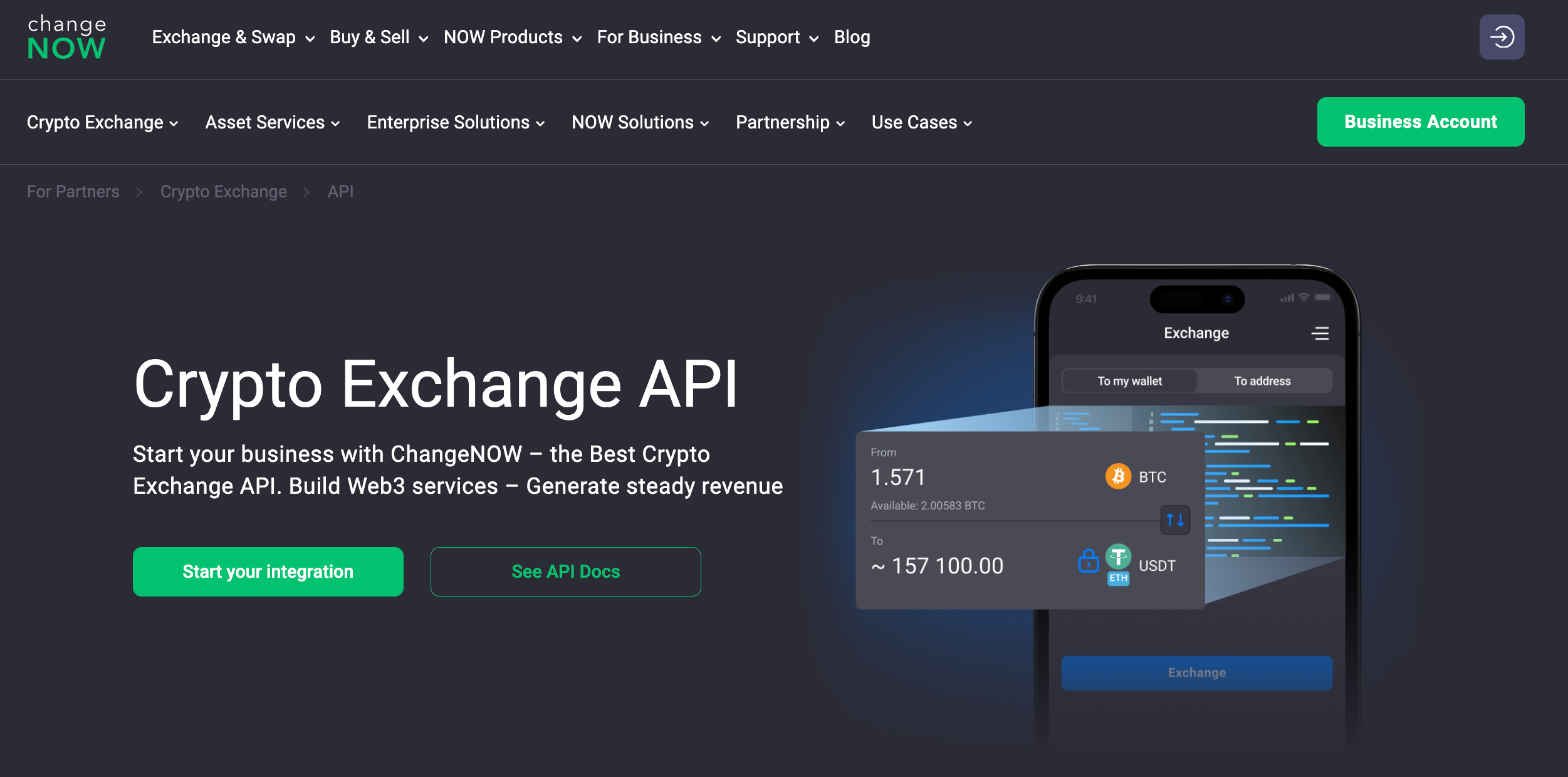
ChangeNOW is a non-custodial exchange, crypto bridge, and liquidity aggregator that facilitates instant cross-chain swaps. It also offers rapid deployment via API or widget integration, with a smart routing engine that pulls liquidity from both CEXs and DEXs to ensure optimal execution.
110+ networks and 1,500+ assets supported.
2,250,000+ exchange pairs available.
Dynamic routing across top CEXs and DEXs for deep liquidity.
All assets, including bridge tokens, are fully interchangeable—no manual bridging or gas management required.
Access to rare and long-tail pairs that are often unavailable on single-exchange listings.
Platform Fees: Revenue sharing starts at 0.4% per transaction, with fully customizable commissions per asset or pair. Fees are baked directly into the quoted rate with zero hidden markups. Partners can also unlock up to 25% in additional monetization through referral programs.
Key Features: Launch in days via API or widget integration. The platform offers both fixed and floating exchange rates: fixed mode locks the price before confirmation, while floating mode executes at real-time market rates. Swaps typically complete in seconds or minutes, depending on the network, with routing that automatically adjusts to market volatility.
Execution & Safety: The system proactively detects common errors, such as incorrect networks or missing memos, to prevent fund loss. If a specific liquidity source fails, fallback execution paths are triggered automatically to keep the transaction moving.
Zero Maintenance: ChangeNOW manages the entire infrastructure, including routing and liquidity sourcing, so you can focus entirely on your business.
What does this mean in practice for users:
Users swap across chains in one flow with no manual bridging, fewer failed transactions, and stable pricing under real conditions.
24/7 technical assistance for any transaction issues, from stuck transfers to deposit errors.
Partners also receive a dedicated personal account manager. Execution holds even when liquidity shifts, long-tail pairs remain available, and fiat on/off-ramps remove the need to switch platforms.
Fiat on- and off-ramps are available on request. Your users can move between cash and crypto seamlessly, without the hassle of registering on external exchanges.
Synapse anchors the blockchain industry as a universal connective layer, closing the gap between isolated networks. Its Interchain Programming Interface breaks down technical silos to forge a unified digital landscape. Rather than operating as a basic crypto bridge, the protocol engineers a robust foundation for native, seamless interactions across every ecosystem.
20+ Blockchains: Covers major EVM networks (Ethereum, Arbitrum, BNB, Polygon) and Solana. The protocol provides the underlying tech for a btc to eth bridge, supports the bnb to eth bridge, and maintains high-volume usdt liquidity for stablecoin swaps.
Hybrid Liquidity Model: Combines native pools for stablecoins (nUSD) and ETH (nETH) with a lock-and-mint mechanism for wrapped xAssets, supporting directional swaps such as eth to avax bridge within the same liquidity framework.
Proven Scale: Over $50B in transaction volume processed across 2M+ users.
Platform Fees: Bridge fees average 0.05% per transaction. For Stableswap pools, the protocol splits fees between liquidity providers (40%) and the treasury (60%). Total costs also factor in source gas and destination execution fees, both of which adjust dynamically based on real-time network conditions and minimums.
Key Features:
RFQ Routing: Cut cross-chain costs by up to 80% with routing that finds the best market price.
Synapse Chain: A dedicated Ethereum L2 built on optimistic rollups for high-speed cross-chain execution.
Generalized Messaging: Trigger contract calls and send arbitrary data across any supported network.
Guard-Based Security: Protect every message with optimistic verification and active fraud proofs.
What does this mean in practice for users: This architecture supports advanced contract interactions across networks, far exceeding the limits of basic token transfers. Stablecoin routes maintain low overhead, though execution pricing shifts with gas spikes and bridge mechanics: particularly outside primary liquidity paths.
Stargate Finance
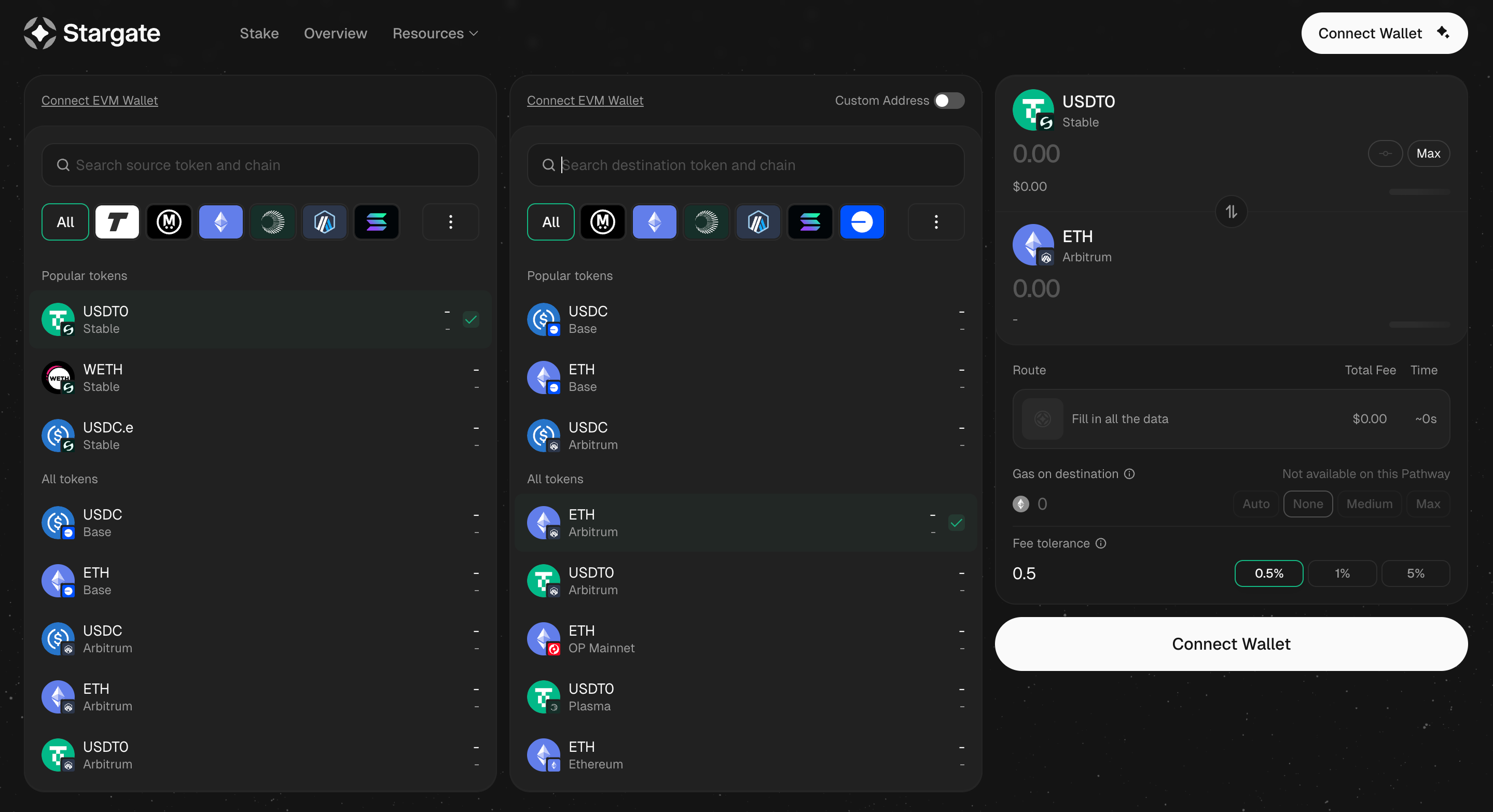
Overview: Stargate Finance is an omnichain liquidity protocol built on LayerZero, specifically engineered to solve the “bridge trilemma.” It enables one-click transfers of native assets with instant guaranteed finality, utilizing a unified liquidity architecture to eliminate the security risks and complexities associated with wrapped or synthetic tokens.
Supported Networks & Liquidity: The network connects 80+ chains, bridging Ethereum, Solana, and BNB Chain with L2s like Arbitrum, Base, Scroll, and Linea. Its routing engine drives native assets, USDC, USDT, ETH, and BTC, and Omnichain Fungible Tokens (OFT) through every supported ecosystem. This infrastructure has already processed over $100B in lifetime volume and currently holds $345M+ in TVL.
Platform Fees: The protocol charges a base transaction fee of 0.06% for non-STG tokens, which is distributed among the protocol treasury (4 bps), veSTG holders (1 bps), and liquidity providers (1 bps). The introduction of Stargate V2’s “Bus” batching mechanism has further optimized efficiency, reducing gas costs by up to 90%, though dynamic rebalancing fees may apply to maintain pool stability across chains.
Key Features:
Low Slippage: The shared liquidity design ensures high capital efficiency and minimal price impact for large-scale transfers.
Native Composability: Direct smart contract integration allows developers to bake cross-chain swaps directly into their dApps.
Native-to-Native UX: Simplifies the user journey by delivering clean, spendable assets on the destination chain without additional unwrapping steps.
What does this mean in practice for users: Move high-volume native assets across chains with minimal slippage and zero extra steps. While the protocol prioritizes cost-efficiency, final rates fluctuate based on real-time pool balancing and routing conditions.
Across Protocol
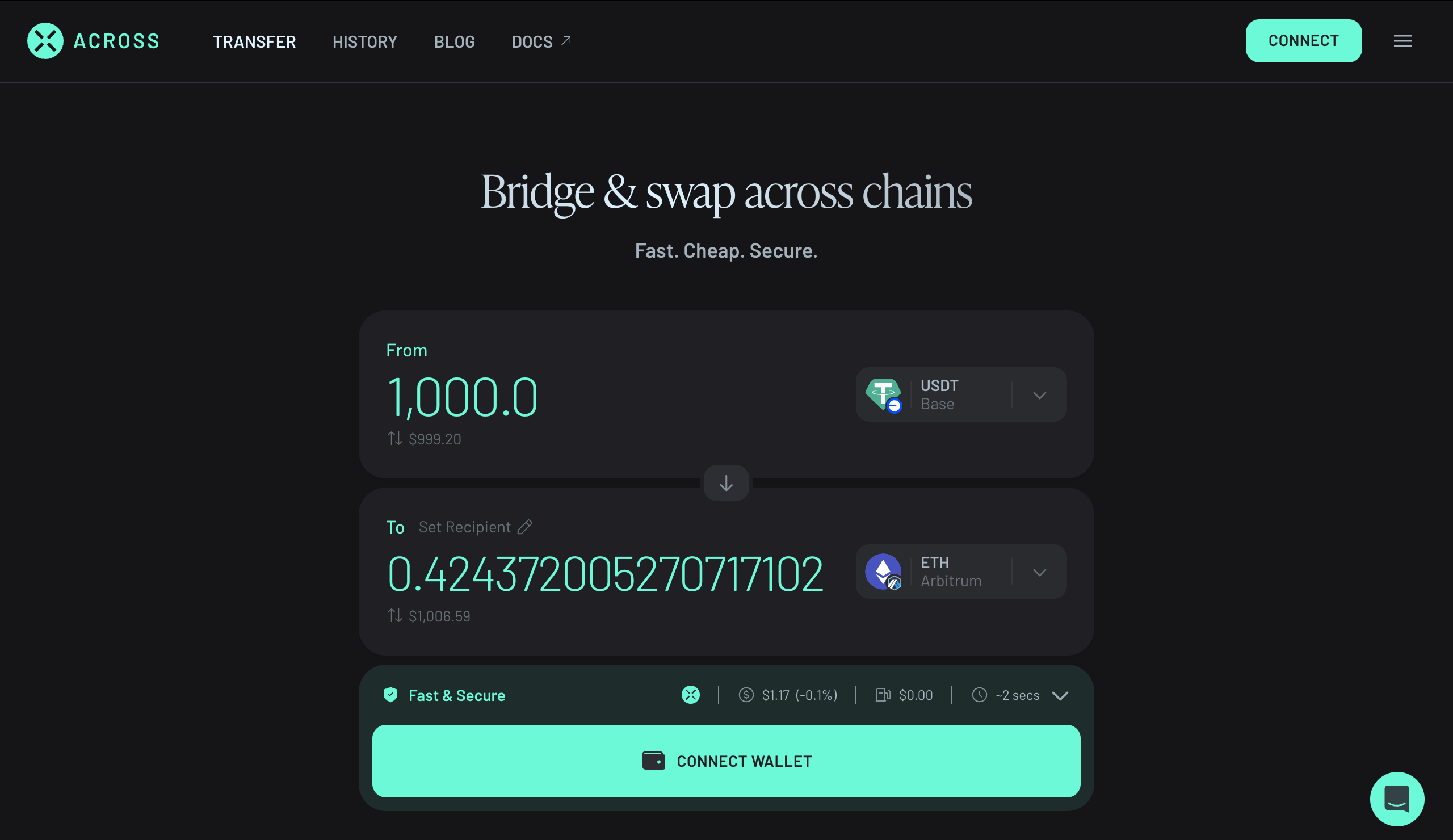
Across employs an intent-driven architecture to decouple user goals from cross-chain execution. Users broadcast signed intents for fillers to execute instantly using private liquidity. This "fill-first" model relies on UMA’s Optimistic Oracle to verify transaction bundles via challenge periods, offloading finality and operational risks to professional solvers who receive reimbursement only after proven delivery.
L2 Ecosystem: Focus on Ethereum and its core scaling layers, such as Arbitrum, Optimism, Polygon, Base, and zkSync. Across serves as a high-speed eth bridge, offering seamless routing for a matic to eth bridge or a direct bridge from polygon to eth.
Assets: Swap assets including ETH, WETH, USDC, USDT, DAI, WBTC, and ACX across the entire network list.
Unified Liquidity Pool: Liquidity is concentrated in a single Ethereum-based pool. This architecture breaks fragmentation and maximizes capital efficiency for every transaction.
Platform Fees: How much you pay depends on a few things: there’s a liquidity pool fee that changes based on how much is in the pool, a relayer fee you can adjust (since relayers take on some of the risk), and a regular gas fee for the network you’re sending to.
Key Features:
Performance & Integration: Finalize transfers in 15–60 seconds via an intent engine purpose-built for direct dApp and wallet embeds.
Expanded Reach: Wormhole integration extends bridging capabilities to networks outside the standard Ethereum L2 stack.
Security & Governance: Oracle-backed settlements protect protocol safety, while the ACX token powers decentralized voting and incentives.
What does this mean in practice for users: While rapid execution remains the standard, full settlement and risk mitigation hinge on backend verification and relayer-side performance.
Portal Bridge
Portal Bridge is the main gateway to the Wormhole protocol, moving assets and arbitrary data between different blockchains. It uses Wormhole’s messaging layer to support advanced cross-chain logic, going beyond basic token transfers to enable full interoperability.
Supported Networks & Liquidity: 30+ networks, connecting Ethereum, Solana, and BNB Chain with L1s like Sui and Aptos. You can use the protocol as a secure bitcoin bridge or to move data between major EVM and non-EVM chains. Also, there is full compatibility across the board, handling everything from standard fungible tokens (ERC-20, SPL) to ERC-721 NFTs.
Platform Fees: Transaction costs start at $0.01. There are no fixed percentage-based fees; users only cover native gas on both the source and destination chains to complete the move.
Key Features:
Guardian Security: Every transaction is protected by a group of 19 independent Guardians. To approve and finalize anything, at least two-thirds of them need to agree.
Asset Management: When you move tokens, they’re wrapped on the destination chain. If you want to get them back to their original form, there’s a burn-and-release process.
Programmable Interoperability: Developers can send all kinds of data with tokens, thanks to built-in cross-chain messaging.
What does this mean in practice for users: The protocol maintains low fee overhead, the wrap-and-mint mechanism produces destination-side assets, dictating specific utility and ecosystem requirements for their further use.
Conclusion
Bridging crypto is a baseline requirement. Siloed assets are effectively dead weight; the moment a user hits a network boundary they can't cross, the product’s value proposition collapses. Friction in the current market is a direct hit to execution quality and capital efficiency.
The real-world performance of these protocols depends entirely on their underlying architecture. We’ve moved past generic transfers into specialized territory: unified liquidity pools tackle slippage for whales, intent-based engines prioritize raw speed, and messaging layers allow for more than just token shuffling. No single protocol wins on every front because each makes a deliberate trade-off—usually sacrificing decentralization for speed or capital depth for security.
Selecting a bridge isn't about finding the "best" tech stack; it’s about identifying your specific point of failure. If you're moving heavy volume, you need liquidity depth. If your app targets retail users, you need low latency and predictable costs. If you’re a lean team, you need to minimize integration debt.
It boils down to what breaks first: the UX or the treasury. The only bridges that matter in 2026 are those that clear a specific bottleneck without piling on operational risk or hidden fees.