Stablecoin payments and adoption are the two focal points of every crypto conference today.
Meanwhile, the people who are supposed to be the end consumers of the world-changing features that projects present are still wondering what to do with all of it and which of those loud updates matter to them.
Today we’re looking at the two biggest card giants, Visa and Mastercard, whose services are used by billions of people worldwide: what they’ve done to bring crypto closer to people and who’s ahead on stablecoin payments. Because if anyone can move crypto adoption from conference slides into real life, it’s those two.
We also spent two days at TOKEN2049 Singapore talking to people who build the rails, among them Faraj Abutalibov from Stellar, Eric Chen, CEO of Injective, and Tyler Bond from NEAR Intents. And our conversations hit right on the practical challenges relevant to this topic.
TL;DR
Visa is more ready for crypto adoption today. And Mastercard is building for 2027.
Visa has more you can use right now: cards that spend stablecoins at ordinary shops, stablecoin payouts, and a number it’s willing to show.
Mastercard invested in its own back-end systems. It’s adding the risk checks banks ask for, but it hasn’t shown how much volume runs through any of it yet.
Both back the same stablecoin, Open USD.
What “ready for adoption” means
For an average user or a business, adoption comes down to four questions:
Can I spend it at a regular shop?
Can I send it across borders?
Can my bank or business plug in without rebuilding everything?
Can anyone check where the money came from?
And an unwritten fifth: can I do all of this without learning how a blockchain works?
That last one is also not the least. During an interview with Ramia Farrage at TOKEN2049, Faraj Abutalibov Senior Advisor at Middle East Stellar, described the change of vibe:
“Even during this conference a lot of people were believing and talking from the stage that blockchain will replace the financial system. Now the majority of the people agree that it just gets embedded in the traditional finance system and makes it cheaper, more efficient, 24/7.”
"Embedded finance" naturally advantages the tech giants and apps you already use every day, but that seamless experience hides a highly fragmented legacy backend.
Speaking to Ramia Farrage for NOW Effect at TOKEN2049, Eric Chen, CEO of Injective, shares his very realistic view on this illusion of immaculate execution:
"The traditional financial world, we kind of glorify it thinking that it's a lot more robust, it's a lot more efficient. But in reality, it's a very, very archaic, very slow moving infrastructure that people over the course of 100 years applied so many patches with credit systems... to make it seem like things are somewhat instant".
Chen pointed out that a single swipe seamlessly triggers a bank, a card network, and multiple backend processors and in reality DeFi is just as complex, but TradFi has simply had more time to hide its plumbing:
"On paper, it sounds equally as complicated. It’s just that we’re more used to it. And more importantly, the overall user experience is more abstracted over time."
Spending: Stablecoin Cards and the Reality of Fees
In both cases, the user holds crypto in an app, taps their card, and the merchant is paid in traditional fiat currency. For the average consumer, the issuing app shapes the experience far more than the network behind it.
One thing to keep in mind: these cards don’t cut anyone’s fees. Because these transactions still run on traditional Visa or Mastercard rails, the networks continue to collect their standard cuts.
However, blockchain-native solutions are already threatening this fee monopoly.
In an interview with Ramia Farrage for NOW Effect at the TOKEN2049 crypto conference, Faraj Abutalibov, Senior Advisor at Middle East at Stellar, highlighted how direct crypto payments are bypassing these traditional rails entirely:
"The crypto cards are all around us, they are in the TOKEN2049, they allow us to pay the fees directly from your wallet, and sometimes in some countries you can embed the QR pay and you don't need to pay visa fees or MasterCard fees, so a lot of fees are removed from the system which brings the efficiency into place."
Cross-border payments: Visa and Mastercard's Strategies
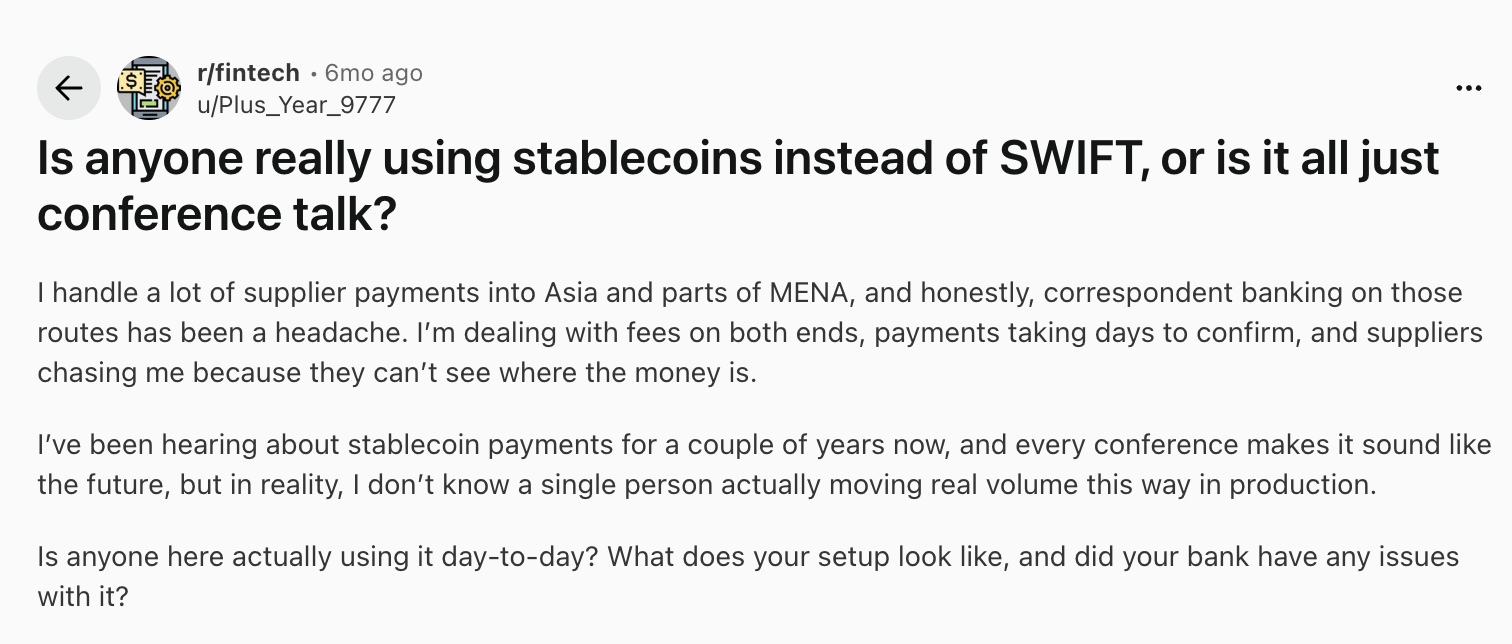
A Reddit user on r/fintech thread asked a real question that sums up that very consumers’ confusion narrative we mentioned at the beginning.
A business owner pays suppliers in Asia and MENA through correspondent banks: fees at both ends, days of waiting, suppliers asking where the money is. Their question was whether anyone actually uses stablecoins for such situations.
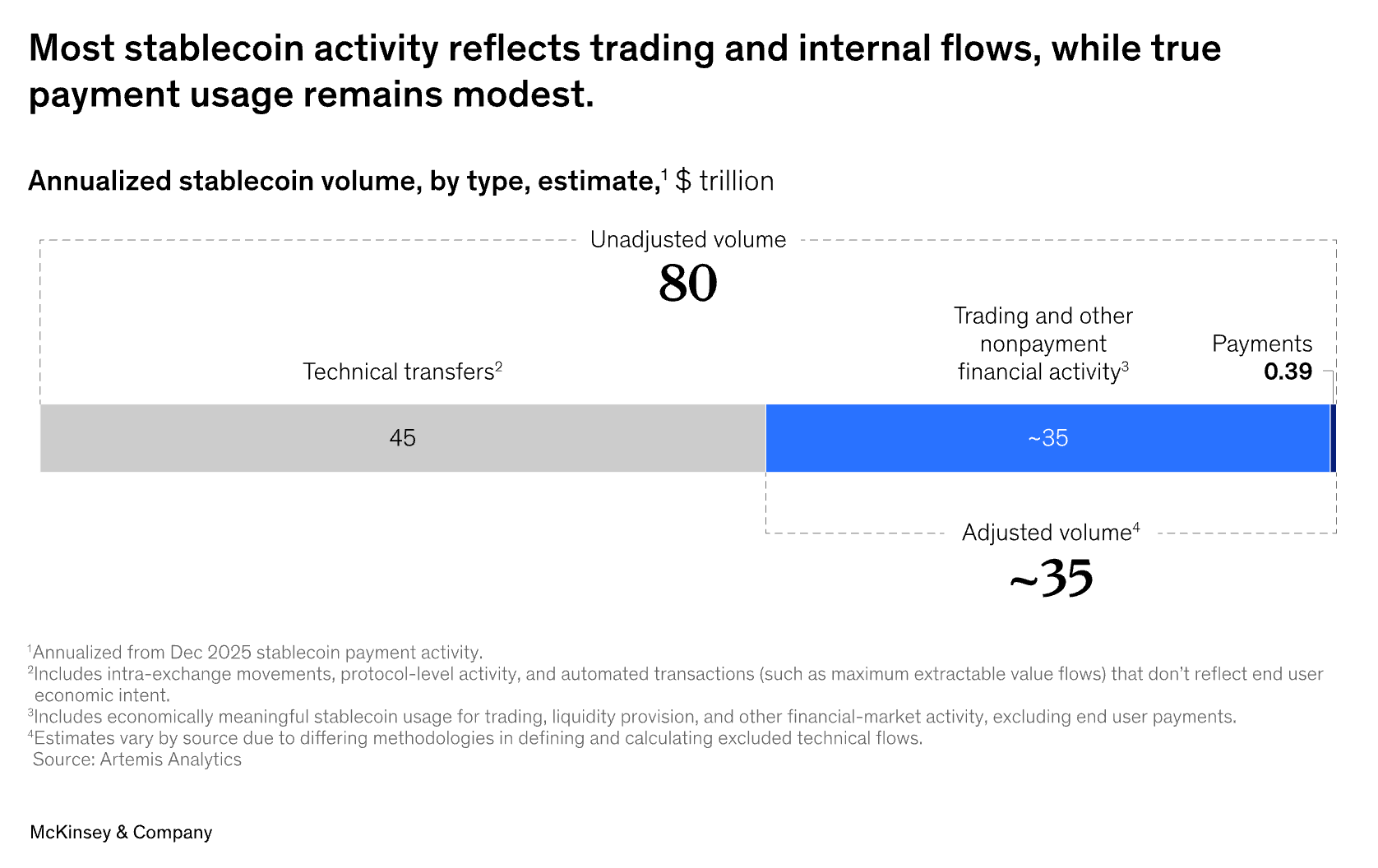
Fair question, and the data gives a mixed answer. Stablecoin cross-border payments are where the real use is: McKinsey and Artemis found that real stablecoin payments are still about 0.02% of global payment volume, but roughly 60% of them are business-to-business and Asia is the biggest source.
They’re growing fast, too: Allium counts $482 billion in the first nine months of 2026, up 45%. So yes, people use them for exactly the purposes mentioned above and the number of users is growing.
Visa and Mastercard are taking different paths to process international stablecoin payments. Visa partners with third-party providers like Zero Hash, while Mastercard bought the crypto payments company BVNK to integrate directly into its network. Both, however, utilize the Stellar blockchain.
Despite crypto technology being significantly cheaper, businesses don't rush to abandon expensive traditional methods like SWIFT because of entrenched habits.
During his interview with Ramia Farrage for NOW Effect, Faraj Abutalibov, Senior Advisor at Middle East at Stellar, quantified this exact pain point, noting that people often stick to what they know, "even if it costs $40 for a swift transaction". He explained the psychology behind this inertia:
"I think, ultimately, no one makes a decision to select a blockchain transfer. Everyone is making decisions based on how much they trust the particular counterparty and the cost."
This gives Visa and Mastercard a massive advantage, as they already possess decades of established global trust.
However, Visa is struggling with the actual underlying infrastructure. After running a pilot with BVNK, Visa lost its partner when Mastercard swooped in and bought BVNK. Visa reportedly issued an RFP for a new settlement partner.
With the BVNK acquisition, Mastercard now controls a unified pipeline and plans to plug it into the new Global Money Platform. Instead of banks needing to build separate integrations for every single blockchain, Mastercard will be able to offer one connection that handles multiple chains and assets.
This creates an "asset-agnostic" system where the underlying currency doesn't matter.
Speaking to Ramia Farrage for NOW Effect at the TOKEN2049 crypto conference, Tyler Bond of NEAR Intents summarized the core value of this approach when talking about multi-chain/multi-asset transactions:
"It actually doesn’t matter what you pay in. It just matters that the receiver gets what they want."
For banks, Mastercard's single-integration approach is the difference between managing one streamlined project versus twenty separate ones.
Risk Management: Screening Stablecoins for Sanctions and Fraud
This is an unglamorous and a very sensitive subject, and banks care about most.
A bank can’t send what it can’t screen. According to a BIS study:
“The degree of complexity varies across transactions, with some operations involving more than 1,000 steps. Because complex transactions each emit multiple transfer events, nearly 60% of all transfer events occur within them.”
On October 19, Mastercard announced Stablecoin Security, an API that scores a stablecoin payment for fraud, scams and sanctions exposure before the money moves on-chain.
It plugs into the fraud and case-management tools a bank already runs - stablecoin payments don’t need a separate risk setup. It starts in North America, with worldwide availability expected in 2027. We didn’t find a Visa product that does the same job.
Common Ground: Visa & Mastercard & Open USD
On September 30, Open USD went live. It’s a dollar stablecoin issued by Open Standard, a company founded by Visa, Mastercard, Coinbase, Stripe and Shopify.
This basically means the payment system and the digital currency are two separate things. Regardless of which company your bank uses to process payments, it can use the same dollar stablecoin.
Start Today: How to Accept And Integrate Stablecoin Payments
You don’t have to wait for Visa and Mastercard to finish battling it out.
If you’re a business and you want to integrate stablecoin payments today, there are three main paths:
Use the major networks: Let Visa and Mastercard handle the settlement behind the scenes without changing your existing technology stack.
Use a specialized API: Connect to an infrastructure provider. This gives you access to multiple blockchains through a single integration, saving you from building separate connections for every coin.
Issue your own: Some large banks (particularly in the UAE) are simply issuing their own stablecoins directly on networks like Stellar.
There is no single "best" payment processor since it depends entirely on what your business needs. A quick cheat sheet:
BVNK, now Mastercard-owned, for one API across many chains.
Bridge, owned by Stripe, if you already live on Stripe.
Zero Hash for a licensed back end. It powers Visa Direct’s stablecoin payouts.
NOWPayments for a crypto payment gateway with an API, invoices and auto-conversion.
Stablecoins For Invoices: Send a Link, Get Paid
Invoicing is where stablecoins transition from a buzzy tech concept to a genuinely useful business tool. You can set a price, let the client pay internationally, and receive funds that won't drop 8% in value before lunch.
Tools like ChangeNOW Payment Link are designed specifically for this. You create an invoice, set the amount, and choose the stable currency you want to receive (like USDT). The client pays in their preferred crypto, the platform handles the conversion automatically, and the exact stable amount lands in your account.
There are no receiving fees, you get a clean PDF receipt for your records, and every link covers one specific payment so orders never get mixed up. You don't even need a website to use it. It's a much easier conversation than trying to explain international wire fees to a supplier.
If you tally up the score, it looks like a tie, but the categories don't carry the same weight.
Visa is winning today. Adoption starts with what people can actually use right now. Visa has over 160 active card programs, cross-border payouts via Visa Direct and Zero Hash that already went live on some markets.
Mastercard is building for tomorrow. Mastercard hasn’t published a stablecoin figure comparable to Visa’s yet but Mastercard CEO Michael Miebach said that cross-border payments are currently the clearest use case for stablecoins.
Their two big moves: buying their own infrastructure - BVNK, and launching built-in fraud screening, are exactly what risk-averse banks need to see before they adopt crypto at scale.
Long story short:
If you want to spend crypto: Either network works. Pick the wallet or app you like best.
If you need to pay international suppliers: Neither network is your best option right now. You are better off using a dedicated crypto payment provider while Visa and Mastercard catch up.
If you work at a bank or fintech: Your big choice is between Visa’s advisory platform and Mastercard’s all-in-one infrastructure. Either way, they can process the exact same stablecoins.
What to watch next
Mastercard’s first real stablecoin number. Until then, the scoreboard has a single runner.
Who replaces BVNK at Visa. It shows how much Visa wants to own its plumbing.
Stablecoin Security outside North America in 2027, and whether Open USD supply moves out of a few wallets.
FAQ
Stablecoin payments are payments made with crypto tokens pegged to a regular currency, usually the US dollar, like USDC or USDT. They move over a blockchain, so they settle in seconds or minutes, any day of the week. Think of them as digital dollars that don’t care about bank hours.
The payer holds a stablecoin, bought with regular money or swapped from other crypto. They send it to the recipient’s wallet address on a blockchain, and it arrives within seconds to minutes, weekends included. The recipient either keeps it or converts it to local currency through a provider. In business setups, an API or a payment link hides the wallet and blockchain parts, so nobody has to think about them.
Pick a provider that fits your setup: a gateway for an online store, an API for a platform, or a payment link for invoices.
Decide which stablecoin and network you’ll accept, and whether to keep it or convert it to local currency.
Send an invoice link or add checkout to your site.
Keep your records, and check your local tax and licensing rules, since they differ by country.
If you’re a freelancer or run a small team, a payment link is the fastest start: create it, send it, get paid.
Yes. Most crypto exchanges and swap services accept Visa debit and credit cards. Some card issuers block crypto-related purchases, so a declined card is usually your bank talking, not the exchange.
On ChangeNOW you can buy crypto with Visa or Mastercard through third-party fiat partners like Guardarian, and swapping one coin for another doesn’t even need an account.