Ask ten people where TRX lands by 2030 and you'll get ten confident numbers, all made up. This TRON price prediction takes a different route. Instead of inventing a target, it maps the conditions that would push TRX higher, and the ones that would sink it. TRON runs a huge share of the world's stablecoin transfers, so the real debate is whether that usage ever shows up in the token's price.
Disclaimer: This article is for informational purposes only and does not constitute investment advice or a recommendation to buy or sell crypto assets. Any views, opinions, or forward-looking statements reflect current market sentiment and publicly available information and should not be relied upon as a basis for investment decisions.
Key Takeaways
The whole TRX debate comes down to one thing: network usage is strong, but strong usage doesn't automatically re-rate a token. Value capture is the open question.
TRON's real moat is cost. Moving stablecoins across it costs a fraction of a cent, which is why it's become default plumbing for USDT transfers.
In the short term, TRX mostly trades as a Bitcoin beta play. If BTC chops, TRX chops.
Can TRX reach $1? Mathematically yes, but it would need a much larger market cap, deeper liquidity, and a bull market doing a lot of the lifting.
Where TRON Stands Right Now
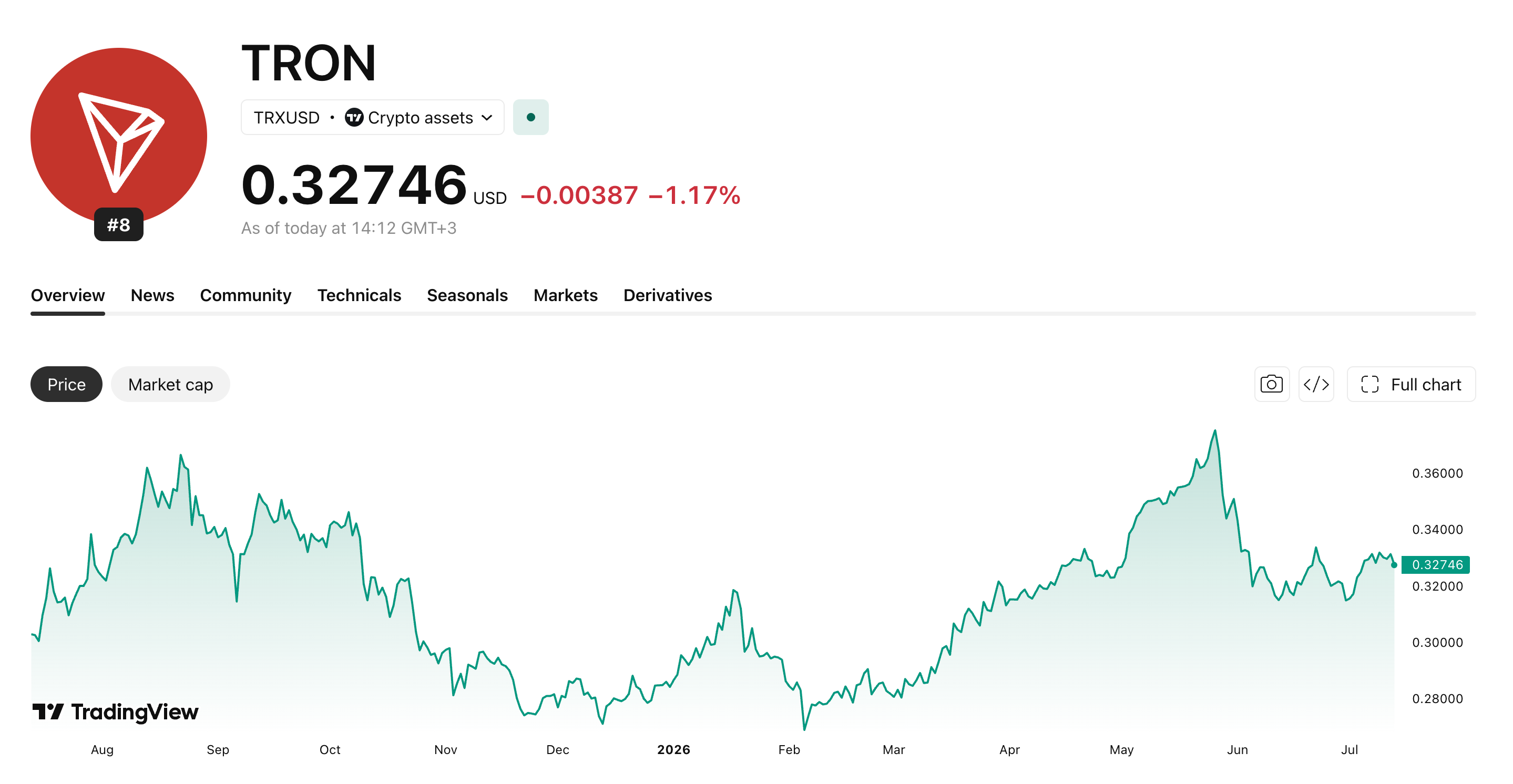
Before any scenario talk, here's the snapshot. TRON sits among the largest smart contract platforms by market cap, a different weight class from the speculative small caps that spike and vanish.
The broader mood matters too. The Fear & Greed Index is a quick read on the room's temperature, it describes the market, not TRON specifically, so treat it as background. When liquidity is tight across crypto, high-utility chains like TRON often lag the shinier narratives before catching up.
The question that drives everything below: can this activity keep expanding, and does any of it translate into stronger demand for TRX itself?
What the Crowd Is Saying
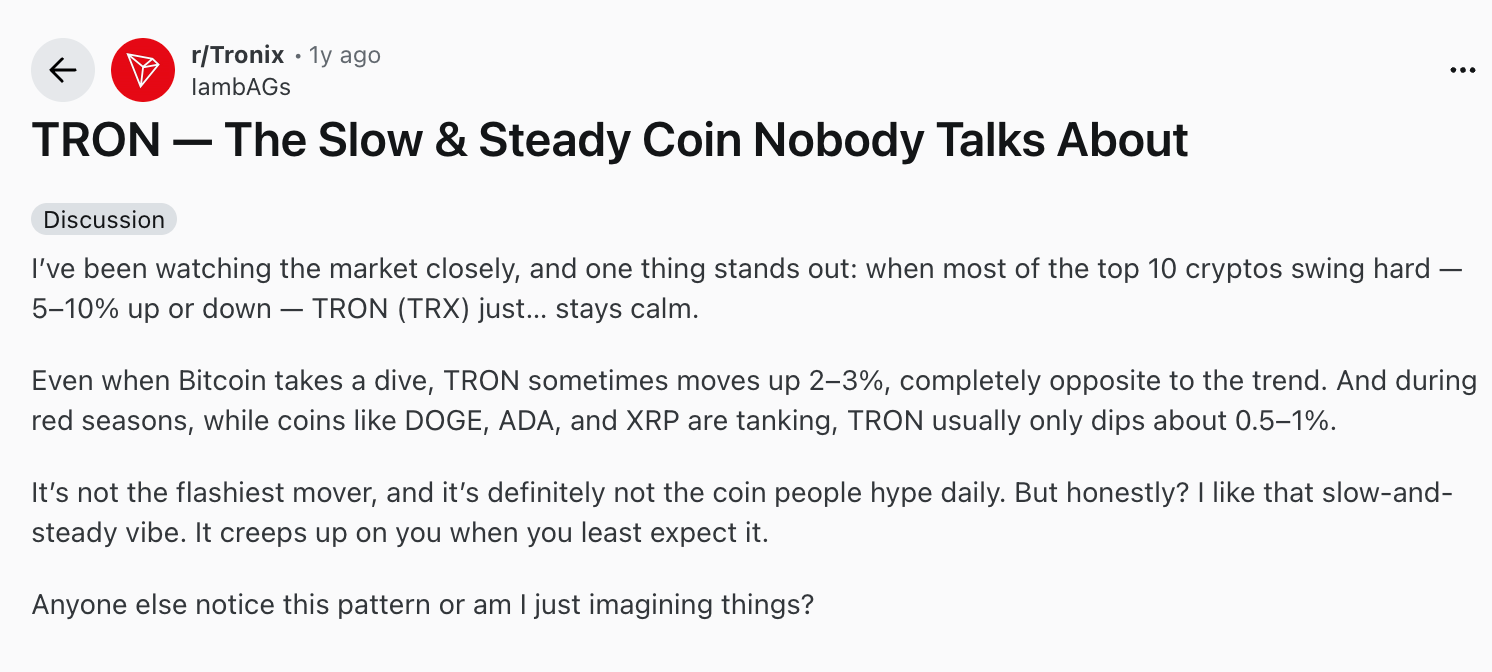
Spend an afternoon in r/Tronix or the on-chain analysis corner of X and you'll hear two arguments running side by side.
The "global payments rail" bull case
This camp points at revenue and volume - TRON generates real fee income because people use it to move money.
What it means is: if TRON is the default rail for USDT transfers, demand for TRX, needed for energy, bandwidth, and governance, should climb as usage climbs. The activity shows up on TRONSCAN and DefiLlama for anyone who wants to check.
The centralization bear case
The counterargument comes mostly from decentralization purists. TRON uses delegated proof-of-stake, with a small set of Super Representatives validating blocks. To critics, that's too few hands on the wheel, a theoretical censorship or single-point-of-failure risk that keeps some institutional money parked on the sidelines. Defenders shrug: for a payment rail, they say, speed and cost beat theoretical decentralization.
Sentiment check. Retail search interest looks steady rather than frothy, no two-week doubling, so the casual speculators aren't piling in. On-chain watchers often flag whales quietly accumulating during flat stretches, moving TRX off exchanges to stake it. Neither pattern predicts a price. Both tell you the conviction crowd hasn't left.
Basic Charts Overview
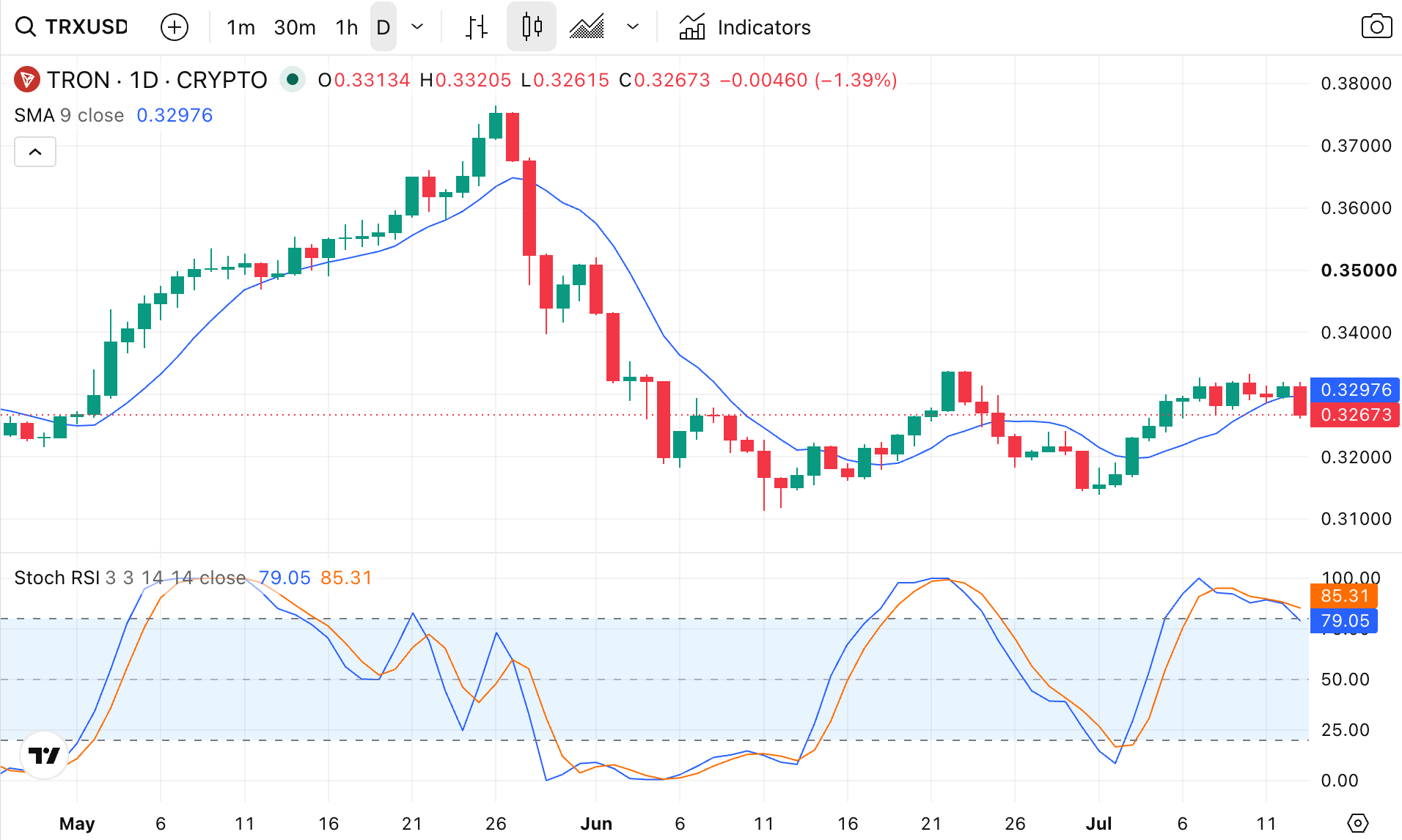
Right now TRX is, technically speaking, boring. Sometimes boring is exactly what precedes a move.
Stochastic RSI: At readings of 85.23 and 78.81, the indicator is in overbought territory. This suggests that recent upward momentum has been aggressive and the asset may be "stretched," meaning a period of consolidation or a short-term pullback is possible as the market becomes exhausted. Unlike a standard RSI, this is more sensitive and best used for timing entries.
Moving averages: The price is trading near its moving average, which is currently acting as a pivot point for the short-term trend. Trading above key MAs supports a bullish trend; losing them signals fading momentum.
MACD: The lines are tightly converged near the zero line, indicating a period of low momentum and consolidation. There is no clear directional signal at this moment; the market is effectively waiting for a catalyst to break the current equilibrium.
Volume: Healthy liquidity without an explosive spike usually means the chart is waiting for a catalyst, not building one on its own.
TRON Price Prediction 2026
Here's what each horizon actually hinges on for TRX short-term and long-term.
TRON Price Prediction Short-Term
Short term, TRX behaves like a Bitcoin beta. When BTC moves a few percent, TRX tends to move more, in the same direction. So as long as Bitcoin chops sideways, expect TRX to chop with it.
The trigger to watch: if BTC breaks to new highs, TRX often lags at first, then plays a fast catch-up as profits rotate into alts. The mirror risk is just as real, if BTC loses key support, higher-beta TRX usually falls harder.
TRON Price Prediction 2026: What Would Have to Happen
A TRX price forecast for 2026 starts with conditions. The bullish 2026 case leans on three signals lining up: network activity holding after recent highs, healthy liquidity, and a broader altcoin recovery.
f active accounts, transaction volume, USDT-TRC20 flows, fee burns, and TVL all stay elevated while TRX trading volume expands, the market may treat TRON as one of the more durable large-cap Layer 1s.
The bearish 2026 case is that a strong month becomes a headline, not a trend. If transactions cool, volume fades, or capital rotates toward Ethereum L2s, Solana, or BNB Chain, TRX can struggle to build momentum even on a solid usage base.
Scenario
What supports it
What breaks it
Bullish 2026
Sustained active accounts, rising transactions, stronger USDT-TRC20 usage, improving liquidity
Weak volume, fewer active wallets, risk-off market, regulatory pressure
Neutral 2026
TRON stays heavily used but TRX trades with the broader market
Tron Price Prediction 2027: Does the Network Narrative Hold?
By 2027, one record month won't matter. Consistency will. If TRON is still posting high daily active wallets, large USDT-TRC20 volume, stable TVL, and real dApp activity across SunSwap, SunPump, and TVM-based apps, the bullish case gets stronger.
The competitive question also sharpens. TRON isn't only up against Ethereum, it's up against Ethereum L2s, Solana, and BNB Chain, all chasing fast, cheap settlement.
The bearish 2027 read: TRON stays busy but gets pigeonholed as a one-trick stablecoin chain, and skeptics argue it's useful without being undervalued.
The 2028 outlook is more speculative because it rides the next crypto cycle. Large-cap alts tend to move with Bitcoin liquidity, the halving rhythm, and overall risk appetite. A stronger bull environment could pull rotation into established Layer 1s like TRON. A bear or low-liquidity phase, and even strong on-chain usage may not be enough for a sustained breakout.
For 2028, the metrics worth tracking:
Daily active wallets and transaction volume;
USDT-TRC20 volume and stablecoin dominance;
TVL and DeFi liquidity;
Fee burns and supply trend;
Staking participation and staking rewards;
Whale activity — large transactions, exchange withdrawals, accumulation;
RSI, MACD, Bollinger bands, moving averages, and Fibonacci retracement zones;
Regulatory scrutiny around stablecoins and cross-border transfers.
Tron Price Prediction 2030: The Long-Term Read
A responsible long-term view focuses on what would make TRON more or less valuable over time.
The bullish long-term case: TRON stays a default settlement layer for stablecoins, payments, and high-volume transfers. Hold strong active-account metrics, deep USDT liquidity, meaningful DeFi usage, and a credible security roadmap, and TRX likely keeps its status as a major utility asset.
The bearish long-term case is the one that haunts every infrastructure token: usage never converts into token demand. A chain can be heavily used, but if people don't need to hold much of the native token, or if fees stay low without real value capture, price upside can trail usage for years.
Security also grows as a factor. NIST finalized its first three post-quantum encryption standards in 2024 and urged early migration because integration takes time. For TRON, the question is whether the ecosystem can communicate a credible long-term security path as quantum concerns move from theory to planning.
What Would Actually Need to Happen
Scenarios are only useful with explicit triggers. Here's what would tip TRX one way or the other, and what would invalidate each thesis.
The bullish triggers
Recent network records get confirmed and followed by continued growth, not a one-off spike.
Daily active wallets and USDT-TRC20 volume keep expanding.
TVL stays resilient; SunSwap, SunPump, and TVM-based dApps pull in more users.
TRX liquidity improves across major exchanges.
Whale flows point to accumulation, not distribution.
The broader market enters a stronger bull phase and stablecoin regulation gets clearer, not harsher.
The bearish triggers
Active accounts and transaction volume decline after a peak.
USDT-TRC20 demand softens; TVL and trading volume fall.
Large exchange inflows from whales suggest distribution.
Competition from Ethereum L2s, Solana, or BNB Chain eats the cheap-transfer niche.
Regulatory scrutiny around stablecoins tightens, or negative compliance headlines cluster.
The single most important variable across both: value capture. TRON can stay useful as payment infrastructure while TRX trades sideways, if the market never sees enough token-level demand.
Verdict
The best TRON price prediction is a test of whether network usage becomes market conviction.
The bullish side has a genuine argument: big active-account metrics, deep stablecoin activity, high transaction volume, a clear settlement use case. The cautious side is just as real, heavy usage doesn't automatically lift a token, and the market still needs to see liquidity, value capture, ecosystem depth, and resilience against regulation and competition.
For 2026–2030, the cleanest read is this: $1 is a possible bullish scenario. TRON needs sustained network growth, broader market support, and a stronger token-demand story to make that target more than a headline.
Want to check the current TRX quote or compare swap routes? You can explore TRON exchange options on ChangeNOW.
That depends on your own risk tolerance, time horizon, and market view. TRON has strong usage metrics and a clear stablecoin-transfer story, but TRX still carries market, regulatory, liquidity, and value-capture risk. This is informational content, not investment advice.
Short answer: yes, in a mathematical sense, but "possible" and "likely" are different words.
At the current circulating supply, $1 TRX implies a market cap in the tens of billions above where it sits today. Not impossible in a large bull market, but it would take much deeper liquidity, stronger demand, and a real re-rating.
In specific use cases, yes. Such as stablecoin transfers, low-cost settlement, payment-style activity. Ethereum stays ahead on developer infrastructure, institutional recognition, and Layer 2 depth. TRON doesn't need to beat Ethereum to stay relevant, though, it needs to keep owning the category where users already pick it.
TRON was founded by Justin Sun, established through the TRON Foundation before moving toward a DAO structure.
2026 would require a major bullish re-rating. 2030 is more plausible in theory thanks to more time for growth and cycles, but it's still not guaranteed.
No one can reliably say. A responsible long-term view sticks to scenarios: sustained growth and strong liquidity support a bullish outlook; weak value capture or regulatory pressure weakens it.
TRX All-time-high is currently $0.375858.
As high as market cap, liquidity, network usage, and token demand expand together. $1 is a popular bullish scenario but would require TRON's market cap to rise substantially from current levels.
Bitcoin correlation, overall crypto liquidity, active accounts, USDT-TRC20 volume, transaction volume, TVL, staking participation, whale activity, exchange flows, regulatory scrutiny, and competition from Ethereum, Solana, BNB Chain, and Ethereum L2s.
Ethereum’s network activity is hitting ATHs, yet its token price recently collapsed to a multi-year low. Is this a temporary market shakeout ahead of the next major upgrade, or is ETH's economic model fundamentally broken?
Learn XAUT price prediction for 2026-2035. Find out everything about Tether Gold. Discover its price, market data, how it works, and where to buy it safely.


 Source:
 Source:
  Source:

