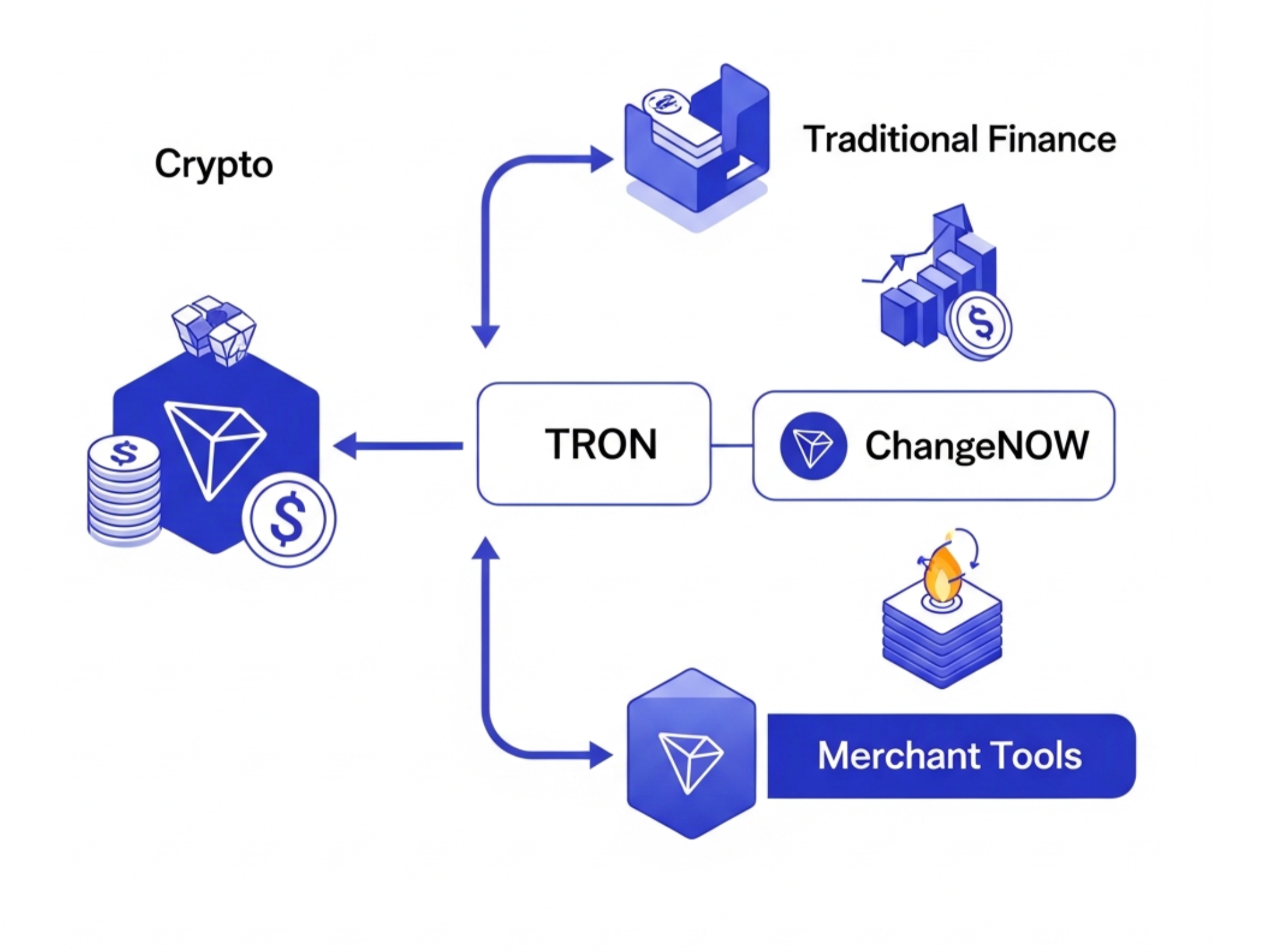
Traditional Finance remains constrained by high fees, slow settlement, and limited cross-border functionality. Stablecoins address these limits by enabling fast, low-cost value transfer, with the TRON network emerging as a reliable bridge between crypto and conventional finance.
ChangeNOW’s fiat-to-crypto gateway provides direct access to TRC-20 assets, combining TRON’s scalable infrastructure with ChangeNOW’s liquidity model to offer a practical, reliable option for both users and merchants.
The TRON Ecosystem: Scalable Infrastructure for Payments
Architecture and Performance
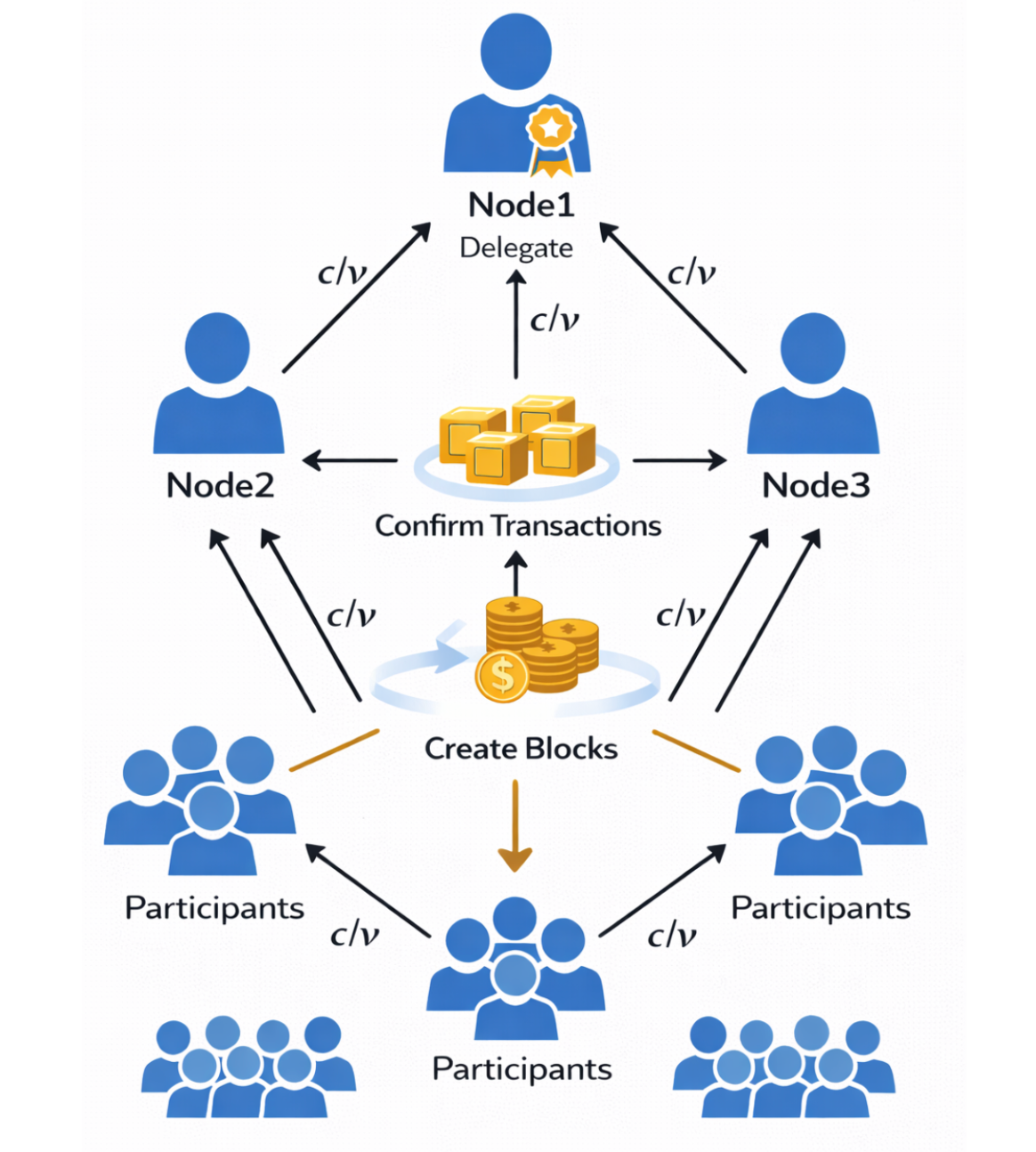
TRON uses a Delegated Proof-of-Stake (DPoS) consensus methodology, which lets it process a lot of transactions quickly and with finality. The network currently processes ~60 TPS in real time, with blocks averaging ~3 s and finality around ~57 s [9]. This makes TRON a compelling infrastructure option for stablecoin transfers, particularly in regard to payments.
TRON’s DPoS model relies on a limited set of elected validators to produce blocks, enabling high throughput and predictable finality. This structure minimizes coordination overhead and supports low-cost, high-frequency payment flows.
TRON is a great alternative for both users and businesses since it has a steady and low-cost price structure, unlike many other networks with uncertain and exorbitant gas rates.
Verdict: TRON's DPoS consensus guarantees high throughput and low latency, which makes it a solid choice for moving stablecoins in apps that deal with many payments.
Ecosystem Scope
The TRON payments infrastructure encompasses millions of daily active addresses and billions in weekly transaction volume, reflecting robust adoption across both individual and enterprise users. These dynamics illustrate how TRON functions not only as a technical blockchain but also as a financial settlement layer.
The TRON network demonstrates impressive scalability and efficiency. All the metrics presented below were taken from Chainspect on Feb, 2026.
Verdict: TRON’s scalable network and low transaction costs position it as an ideal solution for global financial applications, from small transfers to large-scale commercial transactions.
Stablecoins on TRON: USDT Dominance and Economic Significance
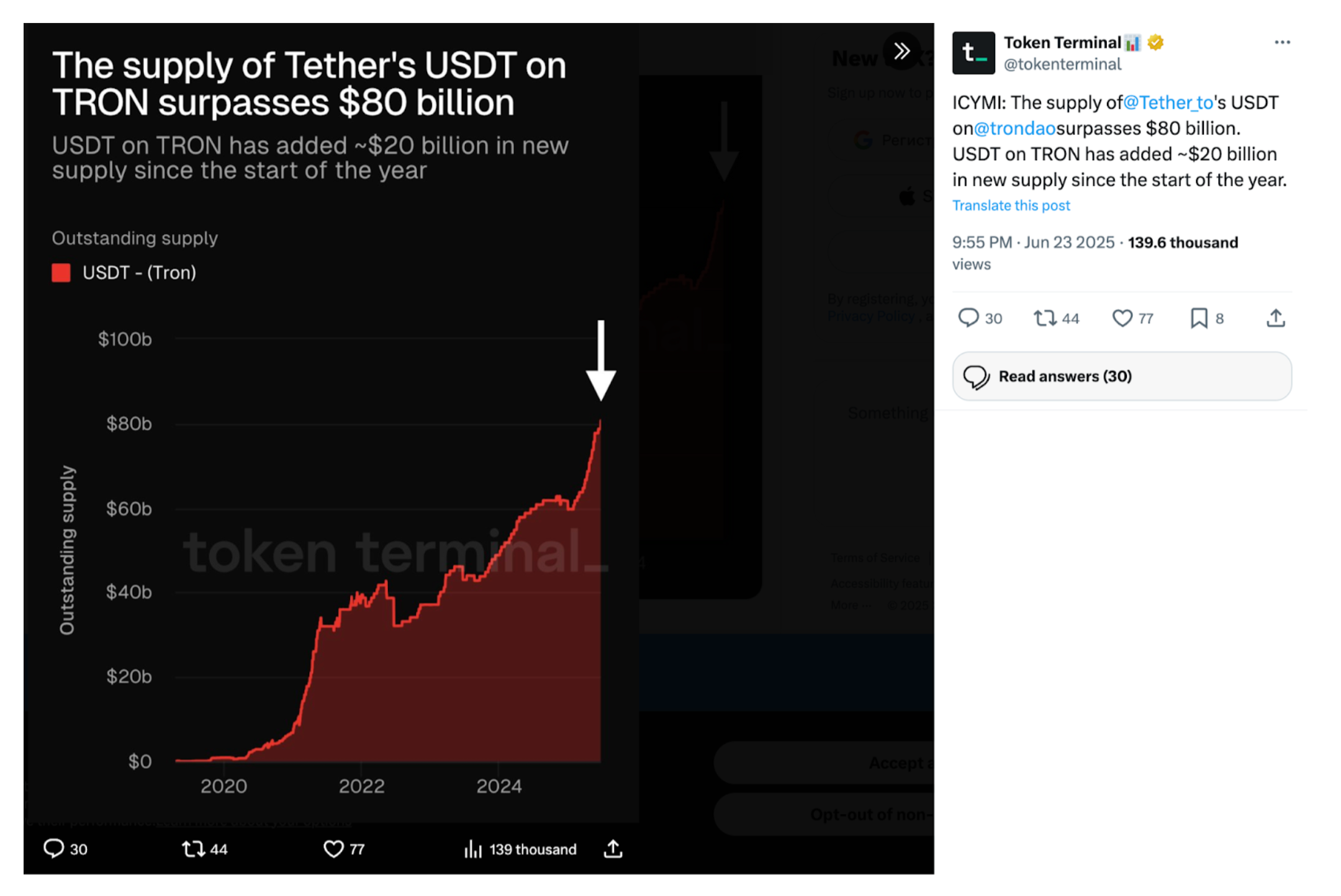
A key pillar of TRON’s financial relevance is its role in stablecoin settlement. According to the latest available Tether Transparency data as of December 16, 2025, the circulating supply of USDT on the TRON (TRC-20) network stands at approximately $80+ billion, accounting for around half of the total USDT in circulation globally.
This fact continues to position TRON as one of the dominant settlement layers for stablecoin transfers, particularly in high-frequency and cross-border payment use cases [1].
This dominance is significant: nearly half of all USDT in circulation is now issued on TRON (via TRC-20), making TRON not just a blockchain but the backbone of cross-chain dollar transfers [2].
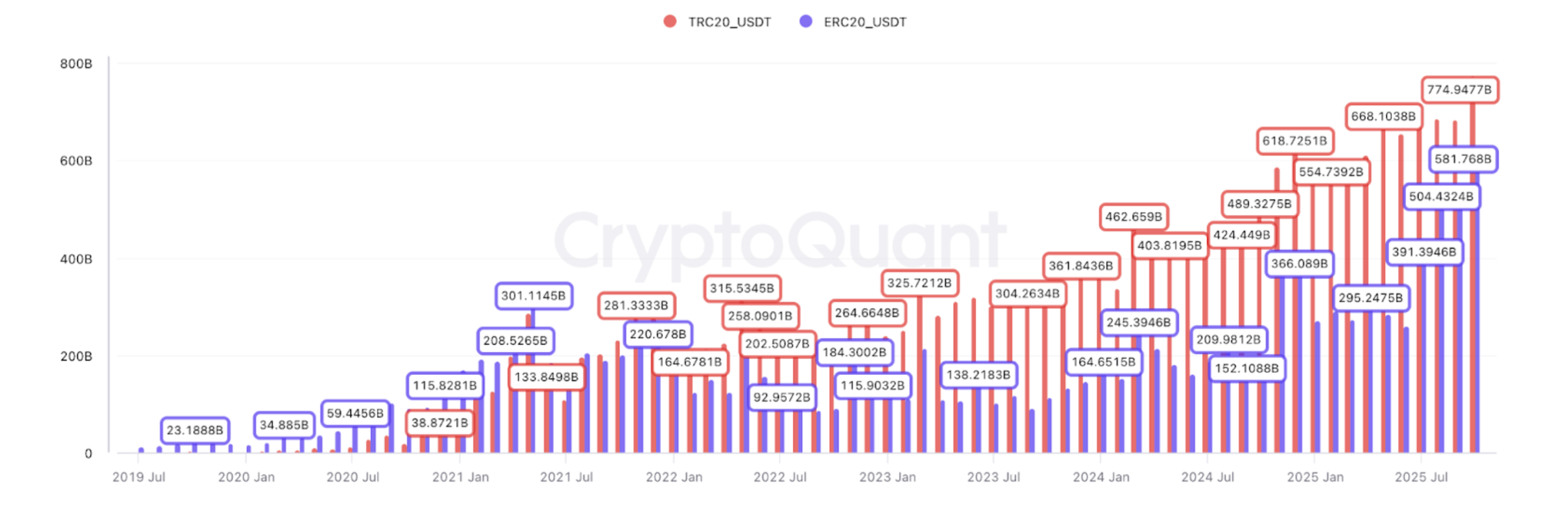
Let’s have a look at the comparative graph of USDT volume on TRC-20 vs. ERC-20.
Compared to ERC-20 networks, TRC-20 USDT transfers on TRON are far more cost-efficient, enabling real-world use cases such as micro-payments, remittances, and merchant settlement.
Verdict: TRON’s USDT issuance has become the foundation for cross-chain transfers, providing a secure and cost-efficient settlement layer for global transactions.
Merchant Adoption: TRON As a Real-World Payment Layer
Traditional Finance Barriers
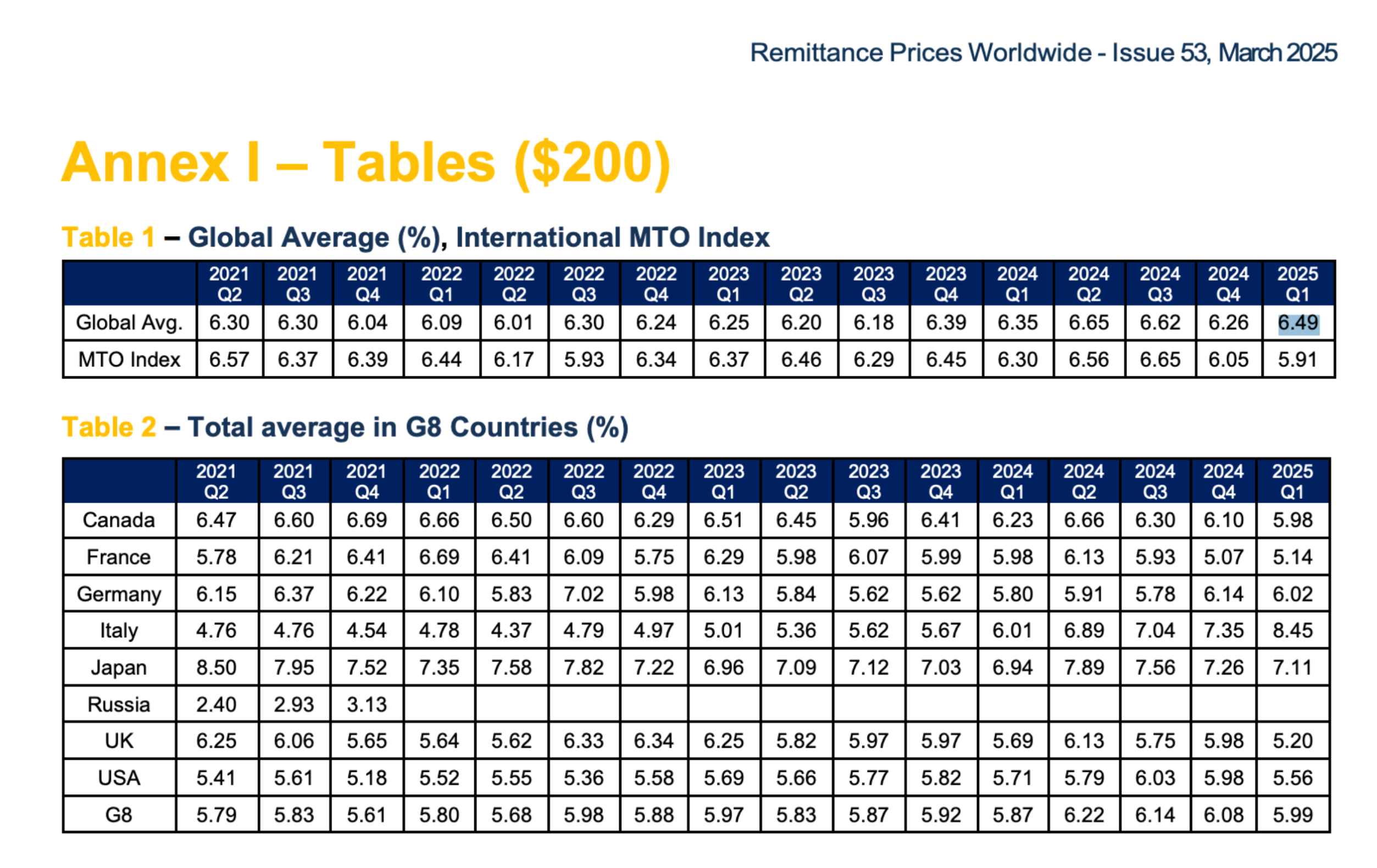
Historically, cross-border transactions that go through traditional networks like SWIFT have always been slow and expensive and rely on many middlemen. Settlement usually takes 2 to 5 days, and costs can vary widely. Furthermore, overseas merchants, freelancers, and remittance providers have less flexibility in how they run their businesses because of liquidity issues.
TRON’s streamlined payments infrastructure overcomes the inefficiencies of traditional finance, enabling faster and more cost-effective cross-border payments. With real-time speeds of ~60 TPS (and a max of 272 TPS over the last 100 blocks), TRON is significantly faster than traditional systems, where cross-border transfers can take 1–5 days. Additionally, TRON’s transaction fees are typically around $0.077, making it hundreds of times cheaper than traditional financial systems, which can charge 5-10% per transaction.
TRON’s Value Proposition
TRON provides a high-throughput settlement layer optimized for stablecoin transfer rails, with TRC-20 USDT acting as the dominant on-chain dollar infrastructure.
Let’s discover the key 2025 metrics:
According to Tether Transparency data as of December 16, 2025, USDT on TRON (TRC-20) exceeds $80 billion, representing a substantial portion of global USDT supply [1].
Fee reduction events decreased average fees by 60–70% across the network [5].
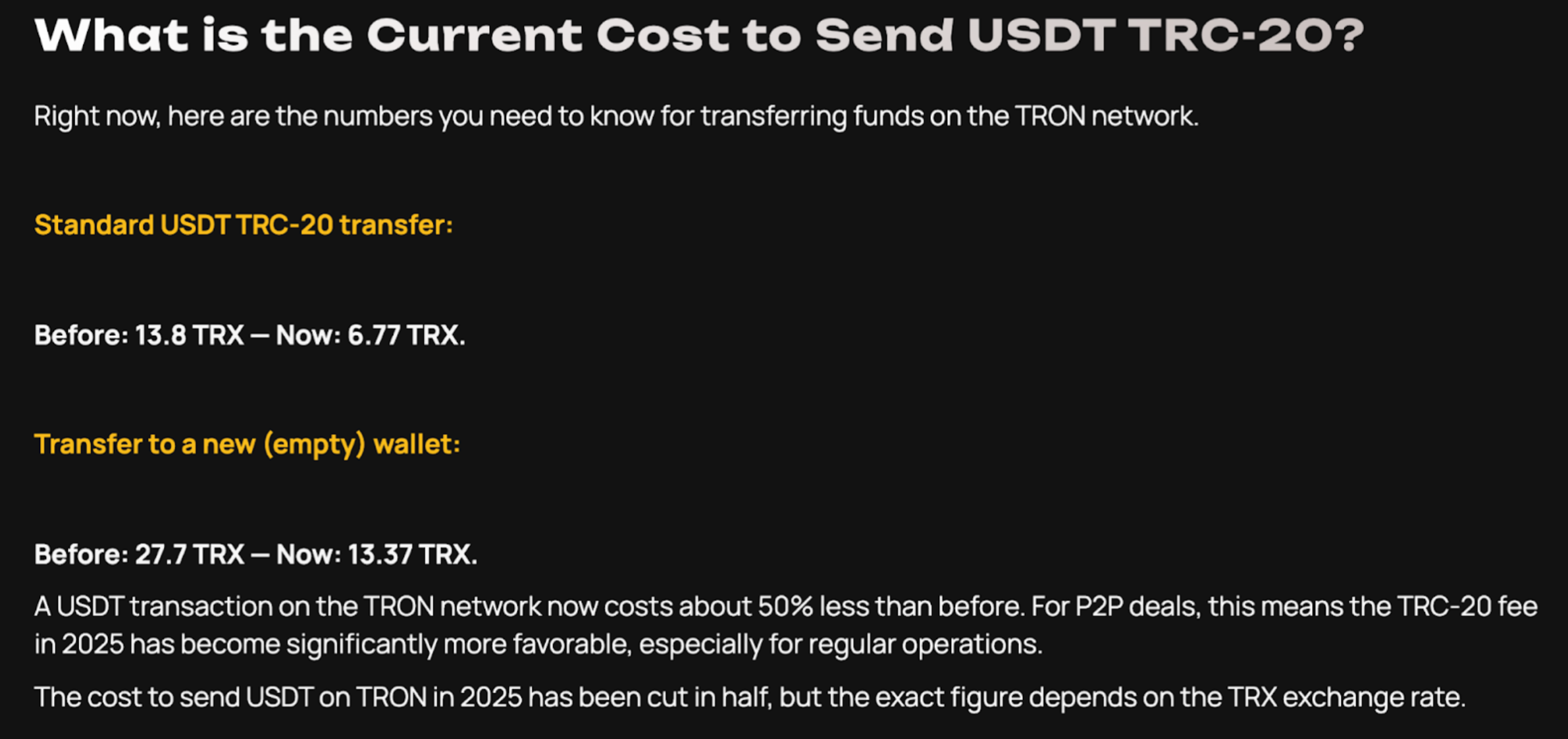
Typical TRON transaction costs (2025)
Thanks to Proposal #104 and the Gas-Free feature, the average fee for TRC-20 USDT transfers is now ~$0.077, regardless of whether wallets already hold USDT or are new/empty.
Combined, these features make TRON a very reliable and cost-effective global payment rail that is especially appealing to enterprises that want to settle payments in a stable currency in real time.
Verdict: TRON solves several of these problems with its quick settlement, low costs, and reliable infrastructure. For businesses, this means being able to use a stable, high-throughput payments system without having to worry about how other blockchains work.
ChangeNOW: Liquidity and On-Ramp for TRON
ChangeNOW's fiat-to-crypto gateway lets you easily switch between more than twenty TRC-20 tokens and many fiat currencies. ChangeNOW lets consumers convert fiat for TRC-20 USDT directly, without any middlemen, which makes the process faster, safer, and more open.
This method makes TRON a liquidity center that connects traditional finance with demand from the crypto world. It also makes it easy for new users to get started quickly on mobile devices, so they can join the TRON ecosystem with little trouble.
You can try out the TRON on-ramp right in the NOW Wallet to see for yourself how easy it is to turn fiat into TRON stablecoins. You can securely store TRON-based assets in the NOW Wallet, which supports TRC-20 tokens and provides full non-custodial control. The wallet allows users to hold, manage, and exchange TRON ecosystem assets without giving up ownership or relying on centralized intermediaries.
To learn more about TRON and stablecoins, refer to the ChangeNOW Blog for a more detailed review.
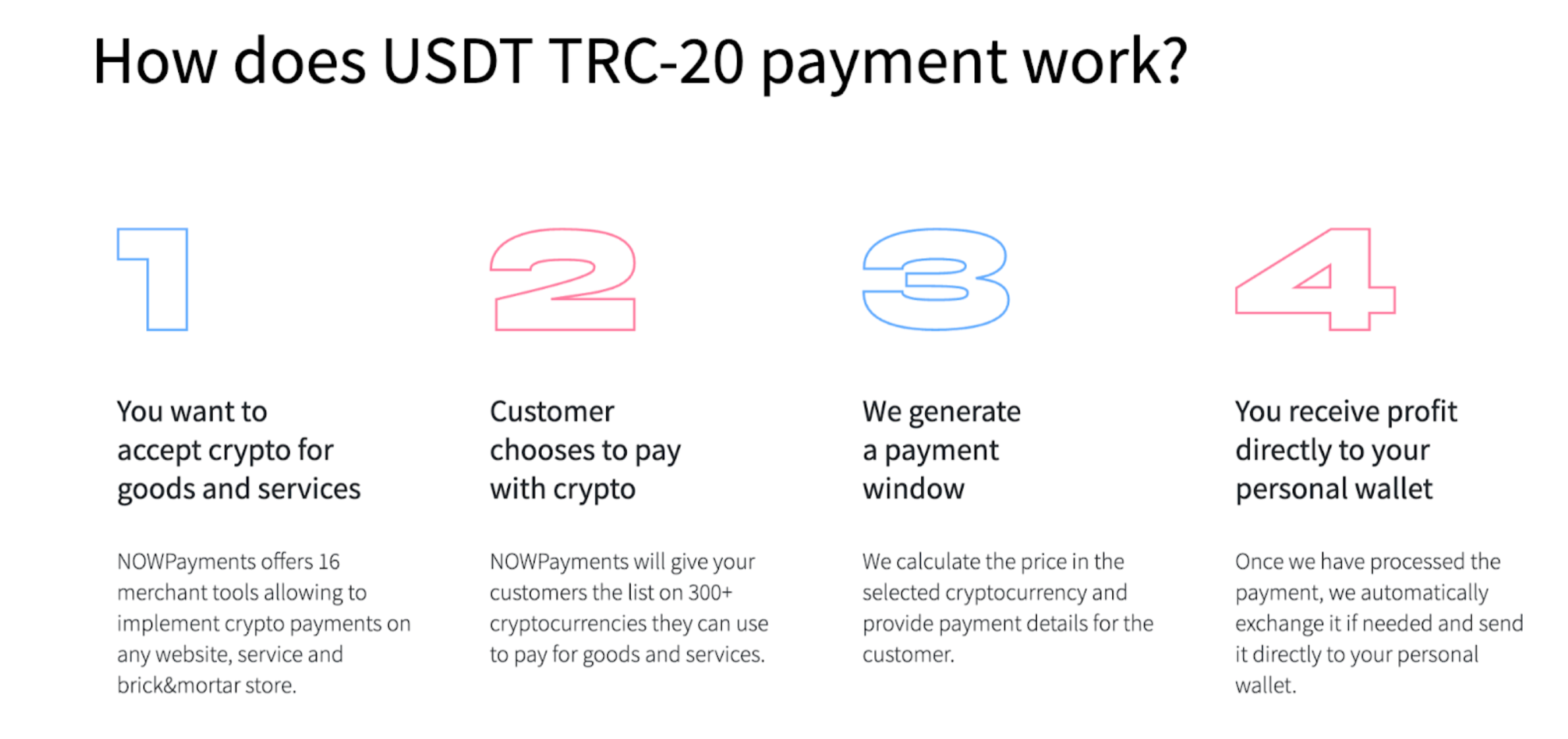
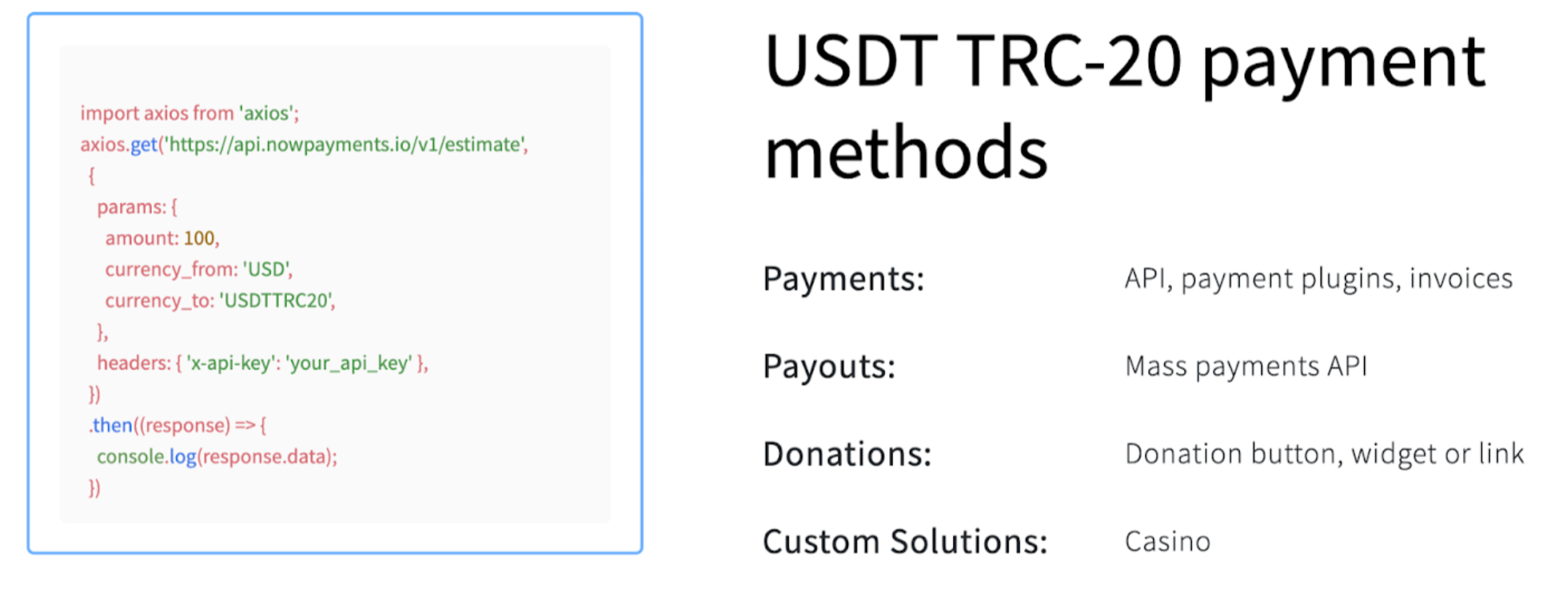
The integration of NOWPayments turns TRON’s stablecoin ecosystem into a practical payment rail for real businesses. Merchants can accept TRC-20 USDT and other TRON-based assets through API, invoices, payment links, or webhooks, making blockchain payments feel as straightforward as traditional digital transactions.
NOWPayments automates the entire process from payment creation to confirmation and payout. Businesses can receive settlements in stablecoins or instantly convert them into local currencies, depending on operational needs [7].
By combining TRON’s low-fee, high-throughput blockchain with NOWPayments’ merchant tools, TRC-20 stablecoins become a commercial-grade settlement method for e-commerce, SaaS platforms, freelancers, and cross-border operations. The result is rapid, cost-efficient, real-time payments without chargebacks, establishing TRON as a reliable payment layer rather than a speculative network.
Ready to accept TRC-20 USDT payments with NOWPayments?
Gas-Free USDT (TRC-20) Wallet: Simplifying the User Experience
A major usability hurdle for TRON’s stablecoin users has been the requirement to hold TRX to pay for transaction fees. The Gas-free wallet TRON feature, currently integrated into NOW Wallet, resolves this by allowing USDT transfers without TRX.
Key benefits include:
Average fee per TRC-20 USDT transfer is ~$0.077, regardless of network load [9]
No need to maintain a TRX balance [8]
Transparent transaction cost structure [8]
This innovation substantially reduces the entrance barrier for both retail consumers and merchants, rendering transfers on TRON more analogous to conventional digital payments than blockchain transactions.
Evidence: Users are able to execute USDT transfers on the TRON network without incurring any TRX fees.
Verdict: Gas-free wallets enhance user experience by lowering entry barriers for newcomers, hence increasing accessibility to TRON for individuals and enterprises alike.
The TRON + ChangeNOW ecosystem can be thought of as a five-layer paradigm that includes blockchain infrastructure, stablecoins, liquidity, merchant tools, and the user experience:
Transport Layer: TRON's high-performance blockchain is the backbone, making sure that transactions are settled quickly and safely. Money Layer: TRC-20 stablecoins, like USDT, are a safe way to trade in the ecosystem. Liquidity Layer: ChangeNOW connects fiat and crypto, letting anyone easily change currencies without going through a middleman. Commerce Layer: NOWPayments makes it easier for businesses to accept TRON-based assets directly, which makes it easier for people to use them in the real world. UX Layer: Gas-free wallets make things easier for users by letting them send money right away and making the onboarding process smooth.
TRON and ChangeNOW are in a favorable position to have a bigger effect in the future because of a few important trends:
Cross-border use of stablecoins is projected to grow faster because of TRON's low-cost infrastructure.
The TRC-20 token will be used for more than just USDT, which will support a wider range of financial applications.
As integration gets easier and more dependable, more merchants will start using it, especially in developing countries.
A smooth experience will help users flourish, and gas-free wallets will make it easier for people to get started.
This path suggests that TRON will become a next-generation financial rail that combines blockchain technology with real-world financial functions.
Verdict: As cross-border use of stablecoins continues to grow and TRON’s infrastructure becomes more integrated, TRON is poised to play a central role in the next generation of global financial systems.
Conclusion
TRON’s rapid, scalable blockchain, TRC-20 USDT transfers, ChangeNOW’s fiat-to-crypto gateway, and gas-free wallets make moving between cash and crypto effortless. Picture sending money to a friend or paying a merchant in seconds – no delays, no hidden fees. For merchants, it means payments flow smoothly every single time. Together, these tools don’t just bring stablecoins and DeFi to life – they make them something you can actually use, every day, without thinking twice.


 TRON’s DPoS model relies on a limited set of elected validators to produce blocks, enabling high throughput and predictable finality. This structure minimizes coordination overhead and supports low-cost, high-frequency payment flows.
TRON is a great alternative for both users and businesses since it has a steady and low-cost price structure, unlike many other networks with uncertain and exorbitant gas rates.
TRON’s DPoS model relies on a limited set of elected validators to produce blocks, enabling high throughput and predictable finality. This structure minimizes coordination overhead and supports low-cost, high-frequency payment flows.
TRON is a great alternative for both users and businesses since it has a steady and low-cost price structure, unlike many other networks with uncertain and exorbitant gas rates.